
Proteins, the molecular workhorses of the cell, owe their functionality to their intricate three-dimensional structures. Understanding the relationship between a protein’s fold, its sequence, and its function is pivotal in unraveling the mysteries of biological processes. In this review, we delve into the captivating realm of protein fold networks and explore how visualizations of these networks can shed light on the interplay between structure, sequence, and function.
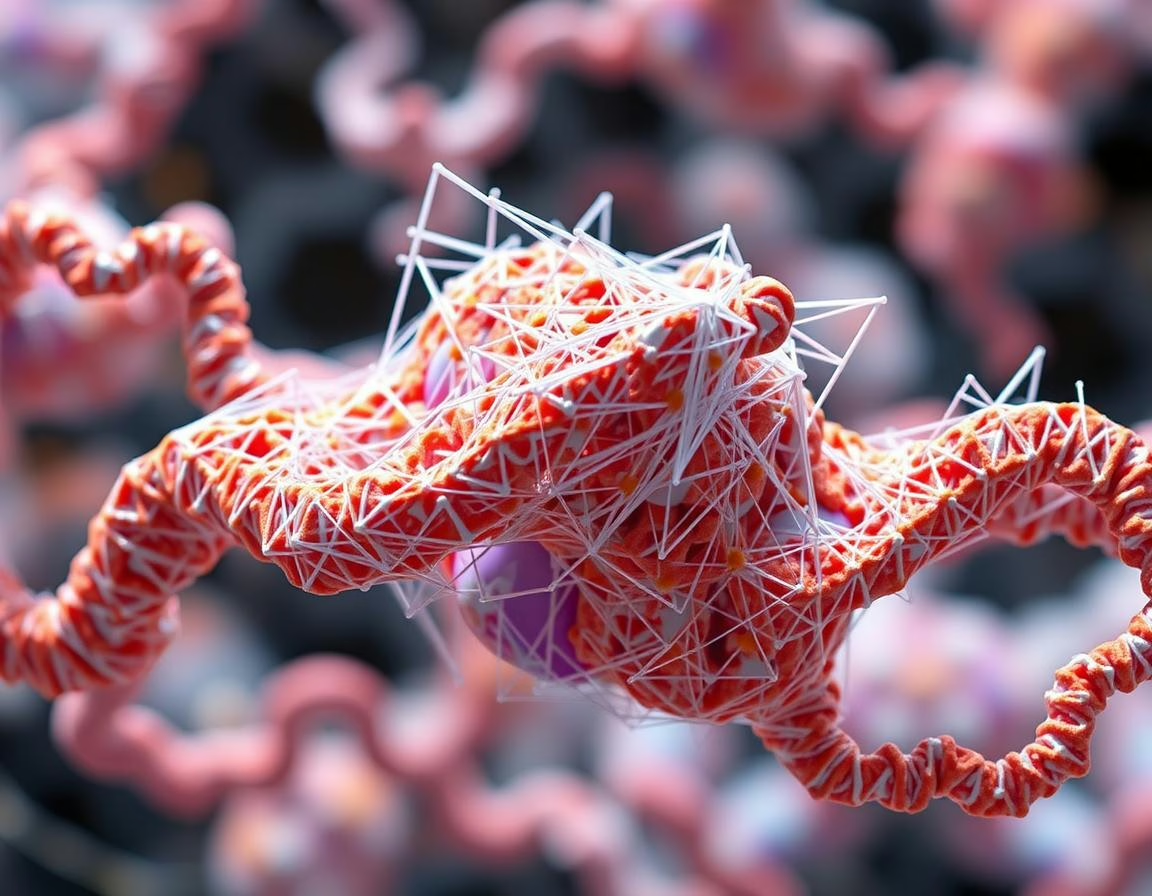
Protein fold networks are a representation of the relationships between different protein structures based on their similarities and differences. These networks provide a holistic view of the protein landscape, highlighting evolutionary connections and functional relationships that may not be apparent from sequence alone. By mapping out these relationships, scientists can gain valuable insights into how proteins have evolved to perform specific functions and how these functions are preserved across different organisms.
Unveiling the Architecture of Protein Fold Networks
The architecture of protein fold networks is akin to a complex web, with nodes representing individual protein structures and edges denoting their similarities or evolutionary relationships. Visualizing these networks allows researchers to identify clusters of proteins with similar folds, elucidating common ancestry and functional similarities. By analyzing the connectivity patterns within these networks, scientists can uncover key structural motifs that are essential for maintaining protein function.
Deciphering the Language of Protein Sequences
Protein sequences, the linear chains of amino acids that make up a protein, encode the information necessary for the protein to adopt its unique fold and carry out its function. Through advanced bioinformatics tools and algorithms, scientists can analyze protein sequences to predict their corresponding three-dimensional structures. By correlating sequence data with structural information, researchers can gain insights into how sequence changes can impact protein folding and function.
Navigating the Evolutionary Landscape of Protein Folds
One of the most fascinating aspects of protein fold networks is their ability to illuminate the evolutionary relationships between different protein families. By tracing the connections between protein structures across species, scientists can reconstruct the evolutionary history of proteins and uncover ancient relationships that have been conserved over millions of years. This evolutionary perspective provides valuable insights into how proteins have diversified and adapted to different environmental pressures.
Mapping the Functional Landscape of Proteins
Beyond their structural similarities, proteins within a fold network often share functional characteristics that are reflected in their biochemical activities. By overlaying functional data onto protein fold networks, researchers can identify clusters of proteins that perform similar functions, even if they have divergent sequences. This approach allows for the prediction of protein function based on structural features, enabling the discovery of novel enzymes and pathways with important biological implications.
Exploring the Intersection of Structure, Sequence, and Function
The convergence of structure, sequence, and function in protein fold networks offers a unique perspective on the inner workings of biological systems. By integrating data from diverse sources, including crystallography, bioinformatics, and functional assays, researchers can construct comprehensive models of protein fold networks that capture the multifaceted nature of protein biology. These integrated models provide a powerful framework for studying protein evolution, engineering novel proteins, and understanding the molecular basis of disease.
Unraveling the Mysteries of Protein Design
Protein engineers leverage the insights gleaned from protein fold networks to design novel proteins with tailored functions for a variety of applications. By analyzing the structural and functional relationships within fold networks, scientists can identify key residues and motifs that are essential for protein stability and activity. This knowledge enables the rational design of proteins with specific properties, such as enhanced catalytic activity or binding affinity, opening up new possibilities for drug discovery, biocatalysis, and biotechnology.
Harnessing the Power of Computational Approaches
Advances in computational biology and machine learning have revolutionized the study of protein fold networks, allowing researchers to analyze vast amounts of structural and sequence data with unprecedented speed and accuracy. By developing algorithms that can predict protein structures, infer evolutionary relationships, and model protein-ligand interactions, scientists are pushing the boundaries of our understanding of protein biology. These computational tools serve as invaluable resources for exploring the complex relationships between protein structure, sequence, and function.
Concluding Remarks
In conclusion, the intricate interplay between protein structure, sequence, and function lies at the heart of biological complexity. Protein fold networks offer a powerful framework for visualizing and exploring these relationships, providing valuable insights into the evolution, design, and function of proteins. By unraveling the mysteries of protein fold networks, we can unlock new possibilities for drug discovery, biotechnology, and understanding the fundamental processes of life.
Key Takeaways:
– Protein fold networks reveal the evolutionary relationships and functional similarities between different protein structures.
– The integration of structural, sequence, and functional data offers a comprehensive view of protein biology.
– Computational tools play a crucial role in analyzing and modeling protein fold networks.
– Understanding protein fold networks is essential for protein engineering and drug discovery.
– The study of protein fold networks sheds light on the complex interplay between structure, sequence, and function.



