
The quest to unveil the origins of life continues to intrigue scientists, leading them to explore the fundamental building blocks of biology. Among these building blocks, RNA has emerged as a pivotal molecule in the early evolution of life. Recent research has introduced a remarkable 45-nucleotide ribozyme, known as QT45, which could illuminate the path from chemical reactions to living organisms.
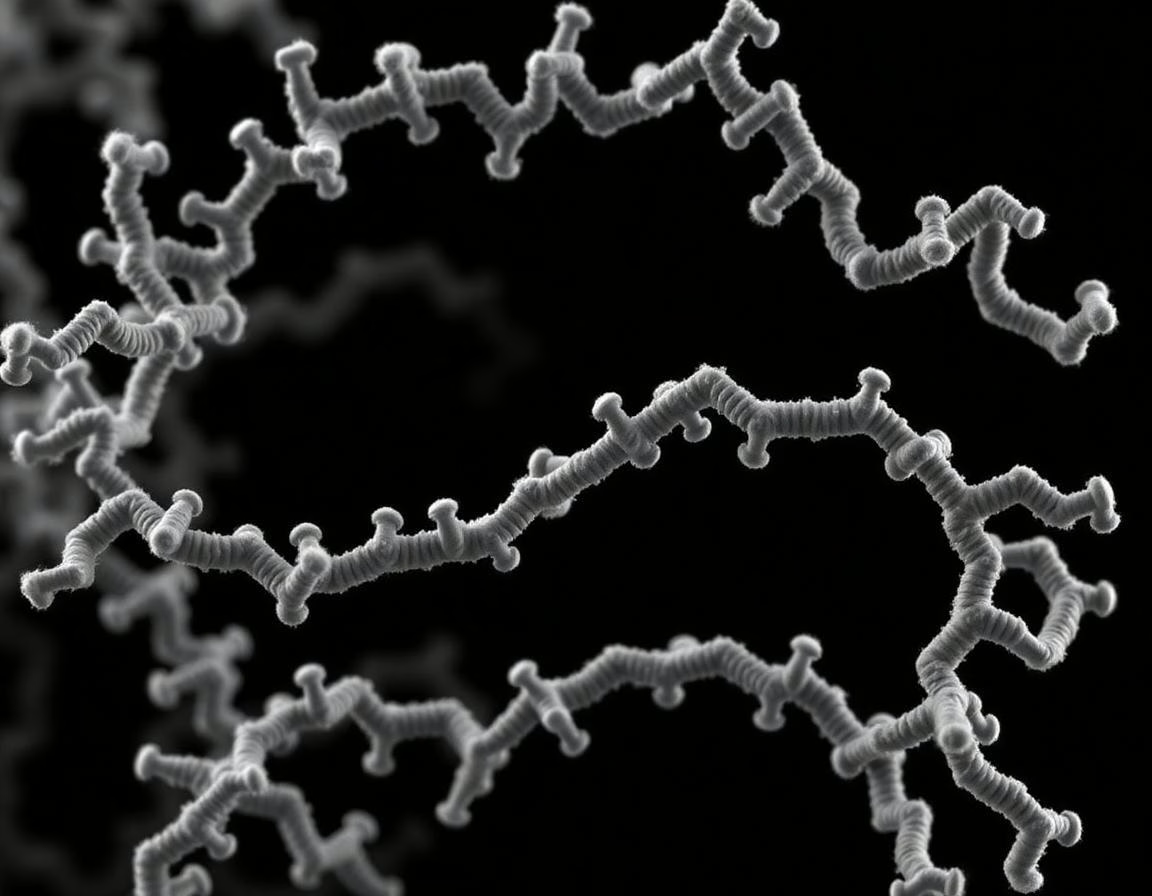
The RNA World Hypothesis
At the heart of this inquiry lies the RNA World hypothesis. This theory suggests that life may have initiated with RNA molecules capable of self-replication. Unlike DNA, which serves as a stable repository of genetic information, RNA possesses the unique ability to both store genetic information and catalyze biochemical reactions. This dual role positions RNA as a prime candidate for the earliest forms of life.
The Challenge of Complexity
Historically, the search for self-replicating RNA molecules faced significant challenges. Most known ribozymes were large and complex, making spontaneous formation in Earth’s primordial environments highly improbable. This complexity created a paradox: the first self-replicating molecules needed to be sophisticated enough to perform their functions, yet their size and intricacy hindered their spontaneous emergence.
Discovering QT45
Researchers at the MRC Laboratory of Molecular Biology in Cambridge challenged the prevailing assumptions by seeking simpler, smaller RNA sequences. They embarked on an ambitious project, generating a diverse pool of roughly one trillion unique RNA sequences. Through an innovative process of in vitro evolution, they meticulously selected and mutated these sequences over multiple rounds until they isolated QT45, a 45-nucleotide ribozyme.
Unique Mechanisms for Replication
QT45 operates under specific conditions that differ from those of modern polymerases. It thrives at sub-zero temperatures and relies on trinucleotide triphosphates—groups of three nucleotides—rather than individual nucleotides for replication. This method not only enhances the efficiency of the copying process but also addresses challenges posed by structured RNA templates, enabling QT45 to synthesize complex sequences, such as the Hammerhead ribozyme.
Self-Replication Potential
The essence of life lies in the ability to replicate oneself. QT45 exhibits this capability, utilizing its own structure to create complementary strands and subsequently rebuild itself. This self-replication process is crucial, as it embodies the fundamental characteristics of living systems.
Limitations and Future Prospects
Despite its groundbreaking potential, QT45 has not yet achieved the ability to replicate itself in a fully autonomous manner. Currently, it can synthesize its complementary strand but requires specific triplets and a hexamer for the backward replication process. Researchers remain optimistic, recognizing that this initial achievement is a significant milestone in the journey toward understanding the origins of life.
The Role of Errors in Evolution
Interestingly, QT45 operates with a replication fidelity of about 93%. While this may seem imprecise, such errors could have played a vital role in early evolutionary processes. Variability may have provided the raw material for natural selection, allowing molecules to adapt and evolve over time.
Structural Insights Awaiting Discovery
One of the intriguing aspects of QT45 is the unknown three-dimensional structure of the ribozyme. Understanding its conformation could shed light on how such a small RNA molecule can perform catalytic functions essential for life. The pursuit of this knowledge presents a new frontier in molecular biology.
Implications for Life’s Emergence
The discovery of QT45 underscores the idea that life’s machinery can be simple and small, evolving from random molecular interactions rather than miraculous occurrences. This research shifts the narrative from a miraculous transition from non-life to life to a more plausible evolutionary process.
In conclusion, the QT45 ribozyme represents a significant breakthrough in our understanding of life’s origins. By demonstrating that a small RNA molecule can replicate itself, this study propels us closer to unraveling the mysteries of early life on Earth. As research progresses, the implications of QT45 may reshape our perceptions of the fundamental processes that led to the emergence of living organisms.
- QT45 is a 45-nucleotide ribozyme capable of self-replication.
- The RNA World hypothesis suggests that life may have begun with RNA.
- QT45 operates efficiently under specific prebiotic conditions.
- The ribozyme functions by using trinucleotide triphosphates for replication.
- Current limitations hinder full autonomous replication, but progress continues.
- The replication errors of QT45 may contribute to evolutionary variability.
Read more → www.zmescience.com



