
Jackson Pollock’s renowned artwork “Number 1A, 1948” has captivated art enthusiasts and experts alike for decades. Its grandeur and historical significance in the realm of modern art are undeniable. However, one aspect of this masterpiece that has long eluded researchers is the identity of the blue pigment used by Pollock. In a groundbreaking discovery, a team of scientists led by conservation scientist Abed Haddad from the Museum of Modern Art (MoMA) and inorganic chemist Edward I. Solomon from Stanford University has finally unveiled the mystery behind the pigment, identifying it as manganese blue.
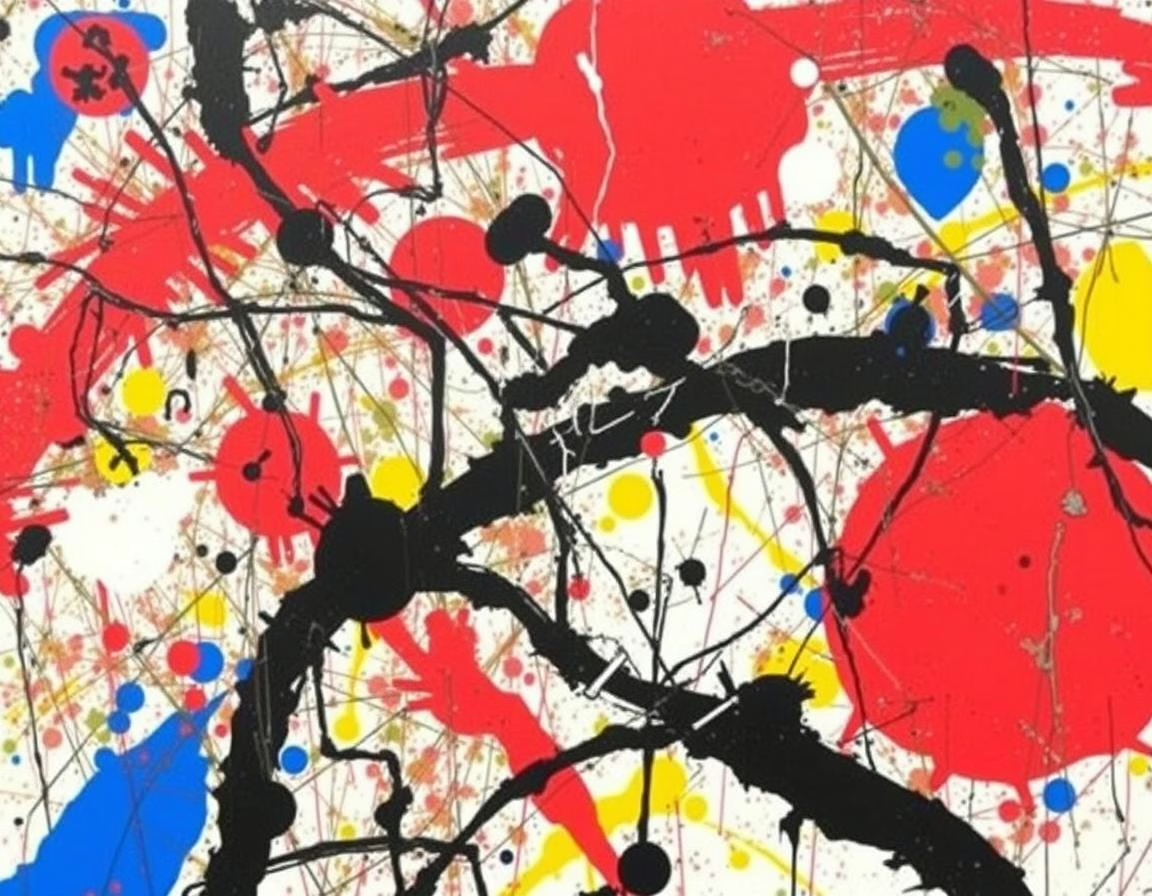
A decade ago, conservation scientists at MoMA initiated the investigation into the pigments present in “Number 1A, 1948” using macro-X-ray fluorescence mapping. While elements characteristic of manganese blue were detected, uncertainty lingered due to the potential presence of similar elements in salts and fillers commonly used in paints. This ambiguity prompted Haddad to employ Raman spectroscopy, a technique adept at discerning chemical structures through laser light scattering. By analyzing a microsample from the painting, Haddad definitively confirmed the presence of manganese blue, resolving the long-standing uncertainty.
Delving Deeper: The Power of Raman Spectroscopy
Raman spectroscopy’s intricacies lie in its ability to unveil molecular structures by examining how light scatters upon interaction with a sample. This technique has revolutionized the field of art conservation by enabling precise pigment identification, shedding light on artists’ intricate color choices.
To elucidate the mechanisms underlying manganese blue’s distinctive blue hue, Haddad collaborated with Dean Lahana and Alexander J. Heyer from Solomon’s lab at Stanford University. Leveraging advanced spectroscopic methods such as resonance Raman spectroscopy and density functional theory calculations, the team delved into the molecular intricacies of the pigment. Their findings revealed that the vibrant blue color of manganese blue stems from electron transitions between the oxide ligands and manganese metal ions, manifesting as absorption bands in the green and purple spectrum, culminating in the iconic blue hue.
Unveiling the Chemistry of Color
The chemical composition of manganese blue, characterized by manganate(VI) centers within a barium sulfate lattice, underscores the intricate interplay of elements giving rise to its vivid blue color. Heyer’s insight into manipulating the pigment’s color by modulating the oxo ligands highlights the potential for tailored pigment creation through controlled interventions. This nuanced understanding of color chemistry not only enriches artistic conservation practices but also opens avenues for innovative pigment development strategies.
While the production of manganese blue ceased in the 1990s due to environmental and health concerns, the implications of this study extend beyond mere pigment identification. The collaborative effort between art conservation and physical inorganic chemistry exemplifies the interdisciplinary nature of scientific inquiry, offering a comprehensive analysis of the pigment’s color properties. This convergence of art and science heralds a new era of exploration at the intersection of creativity and analytical rigor.
Elevating Art through Chemistry
Karen Trentelman, a leading expert in technical studies at the Getty Conservation Institute, lauds the study’s synthesis of artistic and molecular processes, emphasizing the profound synergy between artistry and chemical intricacies. The quest for deeper comprehension of underlying chemical phenomena underscores the curiosity-driven ethos that propels scientific exploration. By unraveling the enigmatic nature of artistic materials, researchers pave the way for a more profound appreciation of the intricate tapestry woven by artists throughout history.
In conclusion, the revelation of manganese blue as the elusive pigment in Jackson Pollock’s seminal work not only enriches our understanding of his artistic process but also exemplifies the transformative power of interdisciplinary collaboration in unraveling complex mysteries. This pivotal discovery serves as a testament to the profound impact of chemistry in illuminating the hidden facets of artistic expression, bridging the realms of art and science with unwavering curiosity and analytical precision.
Key Takeaways:
– The identification of manganese blue in Jackson Pollock’s painting “Number 1A, 1948” showcases the pivotal role of chemistry in unraveling artistic mysteries.
– Advanced spectroscopic techniques such as Raman spectroscopy offer unprecedented insights into the molecular composition of historical artworks.
– The interdisciplinary collaboration between art conservation and inorganic chemistry underscores the transformative potential of merging artistic creativity with scientific inquiry.
– By delving into the nuances of pigment chemistry, researchers pave the way for innovative approaches to pigment development and conservation practices.
– The synergy between art and science exemplifies the profound impact of interdisciplinary research in uncovering the hidden intricacies of artistic masterpieces.
– Continuous exploration at the intersection of art and chemistry promises to unveil new dimensions of artistic expression and conservation methodologies.
Read more on cen.acs.org



