
Researchers have made a groundbreaking advancement in the realm of organoids, demonstrating their potential to learn and improve performance. This novel approach offers a refreshing perspective amid the technological race dominated by silicon-based artificial intelligence.
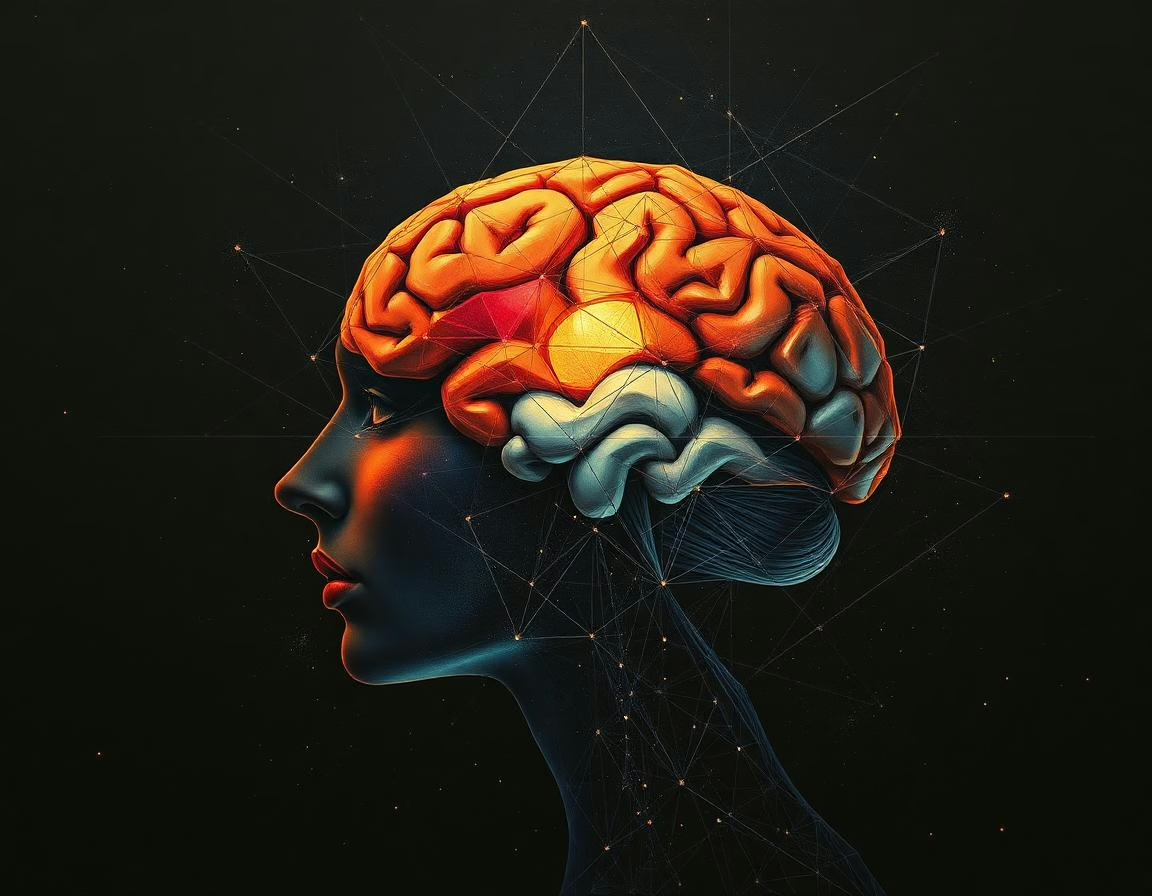
A New Frontier in Brain Research
In a remarkable study published in Cell Reports, scientists at UC Santa Cruz showcased how mouse cortical organoids—tiny, lab-grown clusters of brain tissue—can learn to tackle a complex task. These remarkable mini-brains successfully balanced a virtual pole, a challenge often faced by first-year engineering students. This achievement marks a significant leap in our understanding of organoid capabilities.
The Language of Electrical Signals
The brain communicates through electrical impulses, a language that encompasses everything we perceive and process. Researchers recognized that merely placing cells on a chip would not suffice for meaningful interaction. Instead, they meticulously mapped the organoid’s unique neural architecture using microelectrodes, pinpointing specific input and output neurons.
During the balancing task, the desired behavior was transformed into electrical pulses, stimulating input neurons. The organoid then processed these signals, generating responses that could be decoded into motor commands for movement.
Tackling the Cartpole Challenge
The task itself, known as the cartpole or inverted pendulum problem, can be likened to balancing a ruler upright on the palm of one’s hand. This delicate balancing act requires constant adjustments to prevent the pole from toppling over.
To enhance the organoids’ performance, the research team employed an AI “coach.” Whenever the pole tilted beyond a certain threshold, the algorithm delivered training pulses to the tissue. This intervention triggered synaptic plasticity, effectively rewiring the biological network for greater efficiency.
The Role of AI Coaching
Ph.D. student Ash Robbins, a key contributor to the study, likened the AI coach to a guiding figure, providing feedback on how to improve performance. “It’s like saying, ‘you’re doing it wrong, tweak it a little bit in this way,’” he explained. This coaching mechanism led to remarkable results, with organoids tripling their balance times and maintaining stability for over a minute.
Beyond Reaction: The Power of Improvement
The true breakthrough lay not just in the organoids’ ability to react but in their capacity to improve over time. While current computers are powerful, they often consume excessive energy. In contrast, mammalian brains are remarkably efficient, offering a potential blueprint for developing energy-efficient bioelectronic systems.
By probing how biological networks learn at the “mesoscale”—the interface between a single synapse and an entire brain—researchers may unlock pathways to create computing systems that are not only powerful but also environmentally friendly.
Adaptive Hardware: The Future of Computing
Unlike traditional chips with predetermined structures, these organoids represent a form of “wetware” that can adapt and change in response to various stimuli. This adaptability could provide insights into optimizing processing efficiency in future technologies.
Moreover, the implications for neural rehabilitation are profound. Understanding the electrical patterns that promote plasticity—the brain’s ability to reconfigure itself—opens doors to developing advanced stimulation protocols for individuals suffering from spinal cord injuries or neurodegenerative diseases.
Causal Connectivity: A New Perspective
This research emphasizes the importance of “causal connectivity,” a measure of how signals flow within the brain, as a superior predictor of learning compared to traditional “functional connectivity” maps. The findings suggest that the way signals interact may hold the key to enhancing learning and rehabilitation strategies.
Limitations and Future Directions
Despite these promising developments, the organoids studied represent only a small fraction of the brain’s complex architecture. The researchers used a flat array for growth, limiting their ability to interface with the entire organoid. Furthermore, only a portion of the organoids reached proficiency, leaving questions about why certain biological networks excel while others falter.
In a bid to accelerate progress, the research team has made their platform, dubbed “BrainDance,” open-source. They invite the scientific community to explore and experiment with organoids, testing various learning rules and contributing insights that could propel this field forward.
Conclusion: Paving the Path Ahead
The journey to understanding brain organoids is just beginning, but the potential applications are vast. Whether it leads to greener computing technologies or therapies for paralysis, this research is laying the groundwork for a future where miniaturized brain tissue not only reacts but learns and adapts, revolutionizing our approach to both technology and medicine.
Key Takeaways
- Mouse cortical organoids have demonstrated the ability to learn and improve performance on complex tasks.
- An AI coaching mechanism enhanced the organoids’ efficiency, tripling their balance times.
- The research emphasizes the potential for energy-efficient bioelectronic systems and advanced neural rehabilitation therapies.
- The open-source platform invites collaborative exploration of organoid learning and adaptability.
- Understanding causal connectivity could transform our approach to studying brain function and learning processes.
Read more → www.zmescience.com



