
RNA-targeting small molecules are at the forefront of a revolutionary shift in drug discovery, presenting new therapeutic strategies for diseases once thought resistant to treatment. This article examines recent progress in the realm of RNA-binding small molecules, addressing current challenges while outlining promising research pathways for the future. By focusing on advancements in RNA structure determination techniques and the integration of computational approaches, we can better understand how to design effective RNA-targeted therapies.
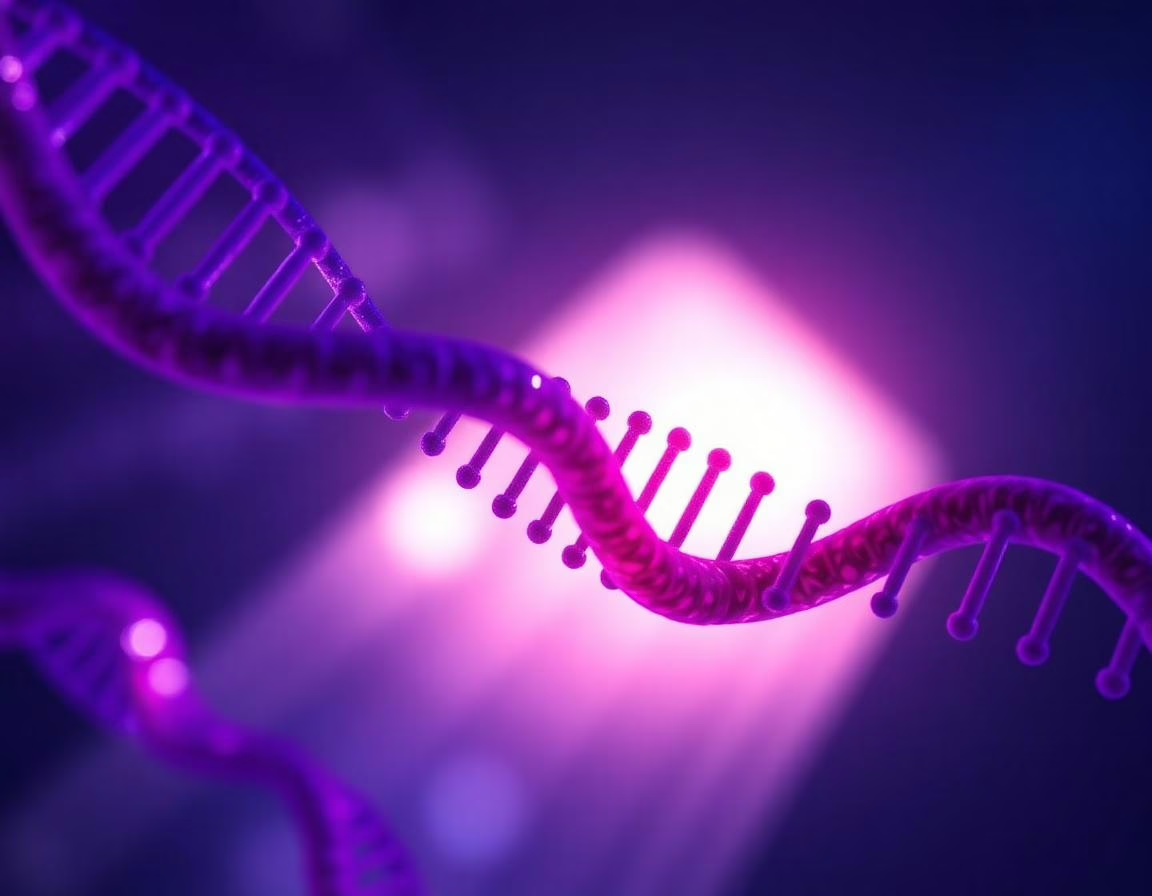
Advances in RNA Structure Determination
Understanding RNA structure is crucial for the development of small molecules that effectively bind to RNA and modulate its function. Techniques such as X-ray crystallography, nuclear magnetic resonance (NMR) spectroscopy, and cryo-electron microscopy have provided essential insights into RNA’s complex architecture. These methods allow researchers to dissect RNA secondary and tertiary structures, laying the groundwork for rational drug design.
Moreover, computational methods have emerged as powerful tools in RNA structure prediction. The advent of machine learning has enabled new approaches that enhance the accuracy of RNA structural models. By leveraging data from known RNA structures, these algorithms can predict the conformations RNA molecules may adopt, facilitating more informed drug design.
The Role of Computational Approaches
Computational strategies are integral to modern RNA-targeted drug discovery. Techniques like molecular docking and deep learning significantly improve the efficiency of ligand screening and RNA structure prediction. By employing these methods, researchers can rapidly identify potential RNA-binding compounds from vast chemical libraries, streamlining the discovery process.
The use of focused libraries and DNA-encoded libraries further enhances the ability to discover bioactive ligands. Fragment-based drug discovery is also gaining traction, as it allows scientists to explore a broader chemical space, leading to the identification of novel RNA-targeting small molecules.
Mechanistic Strategies and Their Impact
Emerging therapeutic strategies, including RNA degraders and modulators of RNA-protein interactions, are broadening the scope of RNA-targeting small molecules. Splicing modulation has proven particularly effective, with FDA-approved drugs like risdiplam showcasing the clinical validity of this approach.
Despite these advancements, challenges remain in achieving the desired specificity and structural novelty of RNA-targeting compounds. Bridging experimental findings with computational predictions is crucial for translating in vitro successes into meaningful clinical applications.
Chemical Probing Techniques and Their Evolution
Chemical probing techniques have played a pivotal role in advancing our understanding of RNA structure and function. Methods such as dimethyl sulfate (DMS) probing and selective 2′-hydroxyl acylation analyzed by primer extension (SHAPE) are widely used to assess RNA reactivity and, consequently, its structural dynamics.
Recent innovations have expanded the capabilities of these techniques, enabling researchers to probe RNA structures in living cells. However, traditional methods often yield averaged structural data, failing to capture the inherent heterogeneity of RNA. Addressing this limitation is vital for advancing our understanding of RNA biology.
Integrative Approaches to RNA Structure Determination
The integration of various structural biology techniques can enhance our comprehension of RNA’s complex nature. While X-ray crystallography has long been a cornerstone in RNA structure determination, challenges in crystal formation often hinder progress. Developing advanced methods for RNA crystal packing and combining X-ray data with NMR and cryo-electron microscopy can yield more comprehensive insights into RNA structures.
NMR spectroscopy, in particular, has shown promise in elucidating RNA structures under near-native conditions, although it faces challenges due to signal overlap and low proton density. New strategies, such as a “divide-and-conquer” approach, have emerged to address these issues, improving our ability to analyze larger RNA molecules.
Future Directions in RNA-Targeted Drug Discovery
Looking ahead, the field of RNA-targeted drug discovery is poised for significant growth. Continued advancements in structure determination techniques, combined with computational modeling and deep learning, will likely enhance our ability to design effective RNA-targeting small molecules.
As researchers increasingly recognize the complexities of RNA structures, a concerted effort to develop more sophisticated probing techniques and computational models will be essential. By addressing these challenges, we can unlock the full potential of RNA-targeting small molecules, transforming therapeutic strategies for a wide array of diseases.
Key Takeaways
- RNA-targeting small molecules are redefining drug discovery, offering innovative strategies for previously hard-to-treat diseases.
- Advances in RNA structure determination techniques and computational modeling are crucial for effective drug design.
-
Emerging strategies, such as RNA degraders, are expanding the therapeutic potential of RNA-targeting compounds.
-
Integrating various structural biology techniques enhances our understanding of RNA and its interactions.
-
Continued research and innovation in probing techniques and computational approaches will drive the future of RNA-targeted therapeutics.
In conclusion, the world of RNA-targeting small molecules is rich with potential, promising to reshape our approach to drug discovery. By overcoming current challenges and leveraging cutting-edge technologies, researchers can unlock new treatment avenues, fundamentally changing how we combat disease.
Read more → pmc.ncbi.nlm.nih.gov



