
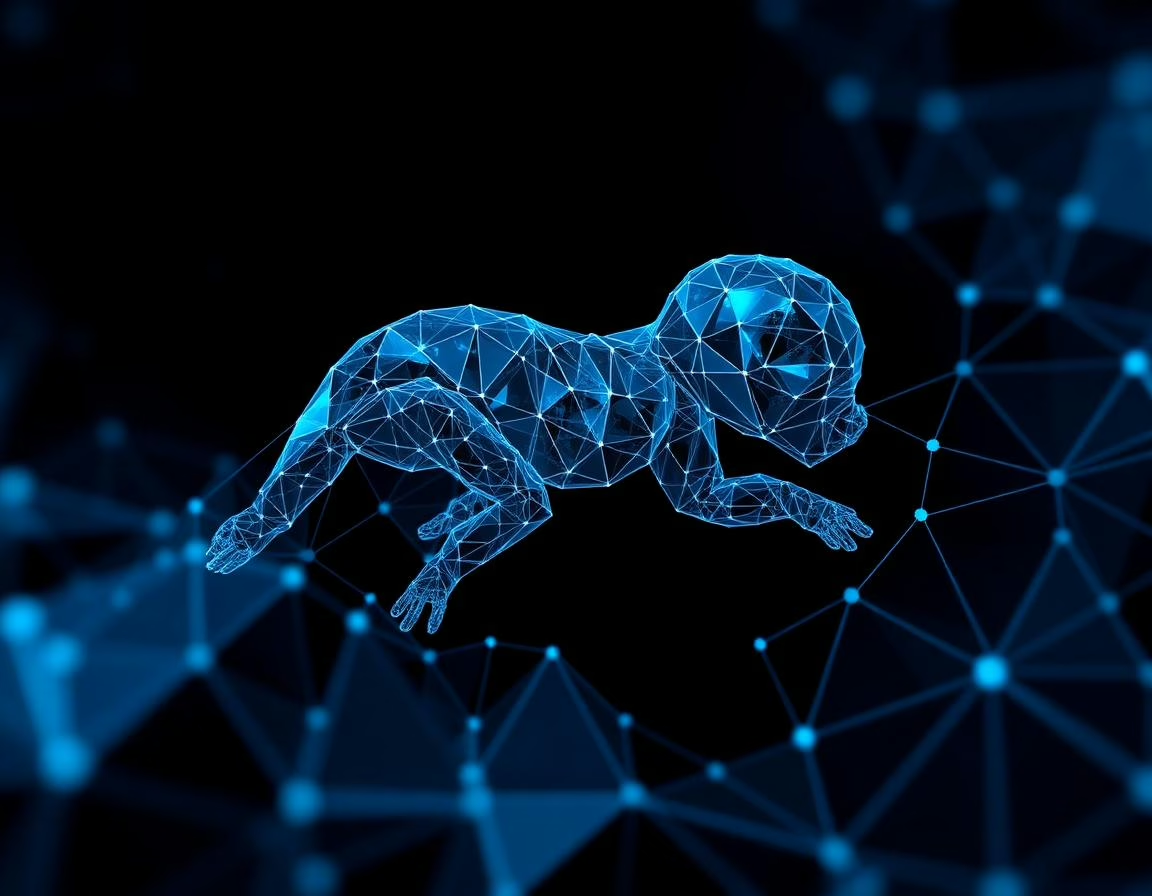
The healthcare landscape underwent a remarkable transformation in 2025, driven by the rapid advancements in artificial intelligence. This pivotal year saw AI making significant strides across various domains, including drug discovery, diagnostics, genomics, and clinical decision-making.
AI systems surpassed human capabilities in intricate diagnostic tasks, enhancing accuracy and speed. The integration of ambient scribes and clinical copilots played a crucial role in alleviating clinician burnout and minimizing time spent on documentation. Additionally, breakthroughs in precision medicine, regenerative tissues, and AI-designed antibiotics marked the year as a turning point for the field. Notably, India emerged as a key player in AI-driven medical science, contributing vital innovations to the global healthcare ecosystem.
Accelerating Drug Discovery
One of the standout innovations in 2025 was the introduction of Boltz-2 AI, a collaborative effort between MIT and Recursion Pharmaceuticals. This advanced model enabled rapid predictions of protein-ligand complex structures and binding affinities, effectively streamlining drug discovery processes. As an open-source tool, Boltz-2 AI accelerated virtual screening, significantly compressing development timelines for new medications.
Revolutionizing Genomics with Evo 2
Evo 2 emerged as a groundbreaking genomic foundation model trained on extensive data from over 128,000 genomes across various species. This open-source model provided a comprehensive snapshot of known living organisms, empowering researchers to generate and predict novel DNA, RNA, and protein sequences. The implications for treatment development, particularly for rare genetic conditions, are profound, paving the way for innovative therapeutic solutions.
Addressing Bias in Pathology
The release of the Pathology Bias Correction AI Tool by Harvard Medical School marked a significant step towards equity in healthcare. By identifying and mitigating biases present in existing AI models used for analyzing pathology samples, this tool enhances cancer diagnosis across diverse populations. It underscores the importance of fairness and accuracy in AI applications within the medical field.
Personalizing Cancer Treatment with OncoMark
OncoMark, developed by scientists at the S. N. Bose National Centre for Basic Sciences in collaboration with Ashoka University, represents a significant leap forward in personalized cancer therapy. Trained on an extensive dataset of 3.1 million single cells from 14 different cancer types, OncoMark predicts how various factors such as metastasis and genomic instability influence tumor growth and therapy resistance. This model provides clinicians with valuable insights to tailor treatments to individual patient profiles.
Smart Doctor: A Clinical Decision Support Revolution
AIIMS New Delhi introduced Smart Doctor, an AI-powered clinical decision support system (CDSS) designed for widespread deployment across 70,000 public and private hospitals in India. This innovative system aims to reduce medical errors while standardizing diagnostic and treatment decisions, particularly for long-term and non-communicable diseases. By enhancing the quality of care, Smart Doctor holds the potential to significantly improve patient outcomes.
Empowering Non-Specialists with MadhuNETrAI
In a groundbreaking initiative, the All India Institute of Medical Sciences launched MadhuNETrAI, a tool designed to enable non-specialist health workers to conduct diabetic retinopathy screenings using AI technology. This model went live in late 2025, serving 38 centers across 11 states. By democratizing access to essential screenings, MadhuNETrAI aims to improve early detection and treatment of diabetic retinopathy in underserved areas.
Garbhini-GA2: Precision in Fetal Age Determination
The Garbhini-GA2 model, developed specifically for Indian contexts, showcased its potential in accurately determining fetal age during the second and third trimesters. While Western models often misestimate gestational age by several days, Garbhini-GA2 reduced this error to under 0.5 days. This accuracy is crucial for predicting preterm births in India, highlighting the model’s significance in maternal and fetal health.
Conclusion
As we reflect on the advancements of 2025, it is clear that AI has fundamentally reshaped healthcare, enhancing efficiency, accuracy, and accessibility. The innovations introduced this year are not merely technical achievements but vital tools that promise to improve patient care and outcomes globally. The future of healthcare is bright, with AI at the forefront of a new era in medicine.
- Key Innovations: AI-powered tools like Boltz-2 AI and Smart Doctor revolutionized drug discovery and clinical decision-making.
- Bias Mitigation: The Pathology Bias Correction AI Tool emphasizes the importance of fairness in medical diagnostics.
- Personalized Care: OncoMark and Evo 2 enable a more tailored approach to cancer therapy and genetic treatment strategies.
- Accessibility: MadhuNETrAI and Garbhini-GA2 enhance healthcare accessibility for non-specialists and improve maternal health outcomes.
Source: www.theweek.in



