
NVIDIA has made a significant advancement in protein structure prediction by integrating its BioNeMo Agent Toolkit with Anthropic’s Claude Science AI platform. This collaboration is poised to accelerate drug discovery and enhance R&D efforts within the life sciences sector.
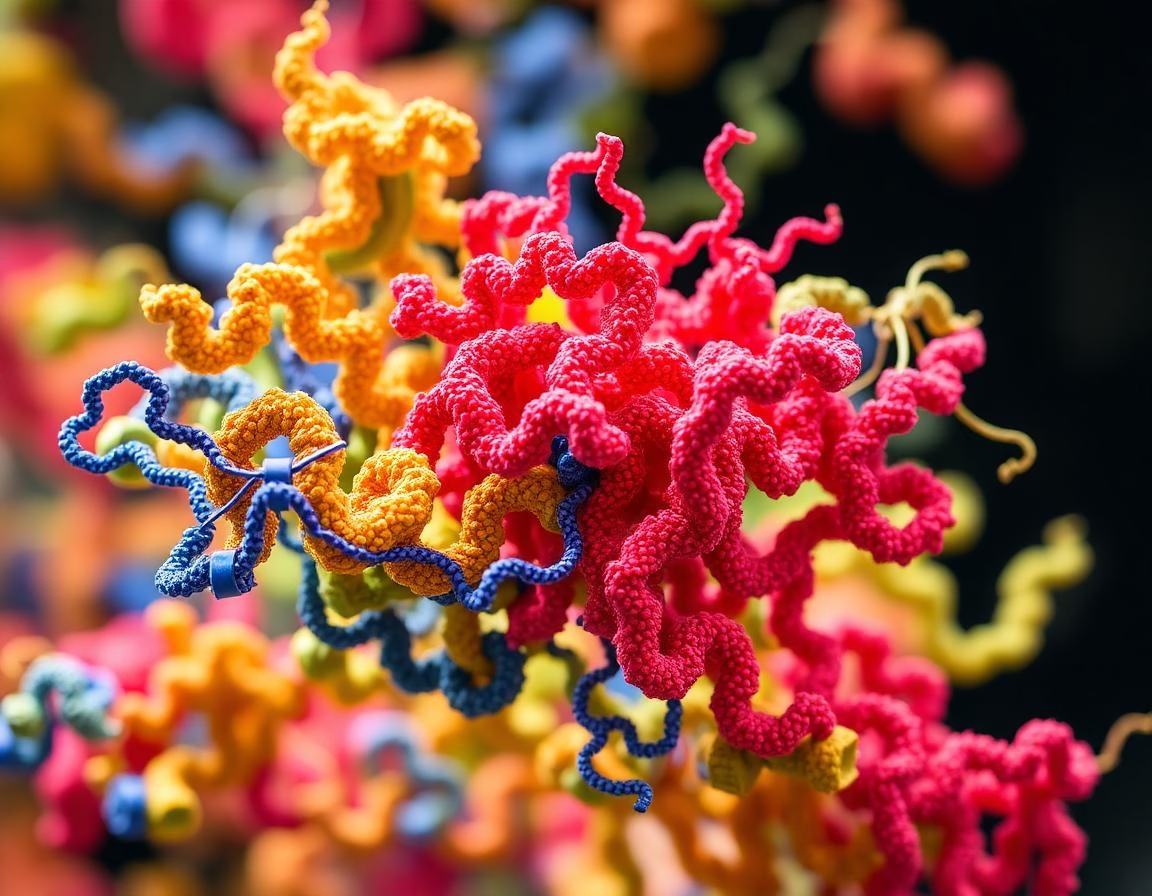
BioNeMo’s Advanced Capabilities
The BioNeMo ecosystem, developed by NVIDIA, encapsulates over ten years of expertise in biomolecular modeling, offering tools that are ready for API integration. By combining BioNeMo with Claude Science, researchers can automate complex tasks such as protein structure predictions, multiple-sequence alignments (MSAs), and the co-folding of protein complexes, all powered by GPU-accelerated workflows. Benchmarks from NVIDIA indicate that the BioNeMo Agent Toolkit has significantly improved task accuracy from 60% to 100%, while also doubling token efficiency.
Addressing Structural Biology Challenges
This integration is particularly valuable for researchers focusing on protein-protein interactions and structural biology issues. NVIDIA highlighted a case where the workflow successfully predicted interactions between the Seh1 nuclear-pore protein and a Mio-family partner from Paracoccidioides lutzii, a fungus linked to paracoccidioidomycosis. Using independent modeling tools like OpenFold3 and Boltz-2, the predicted interactions were validated, with both models arriving at similar structural conclusions. However, the ultimate biological accuracy of these predictions will depend on further experimental validation.
Flexible Research Environment
The platform provides researchers with the flexibility to run Claude Science alongside NVIDIA’s BioNeMo NIM microservices on various setups, including local GPUs, remote GPUs, or cloud environments. NVIDIA offers detailed tutorials and specifies the necessary hardware, including an NVIDIA L40S or H100 GPU and a minimum of 700 GB of storage for managing large datasets like UniRef30, which occupies 490 GB, along with containers for the OpenFold3 and Boltz-2 models.
NVIDIA’s Expanding Role in Life Sciences
This development highlights NVIDIA’s increasing presence in the life sciences arena. The BioNeMo platform has already established itself as a crucial tool in AI-driven drug discovery, facilitating applications ranging from molecular docking to generative protein design and genomic analysis. By integrating its advanced AI tools into platforms like Claude Science, NVIDIA is not only shortening research timelines but also making complex biomolecular modeling more accessible to a broader range of researchers.
Strategic Implications for Investors
For investors, this announcement is a strong indication of NVIDIA’s strategic shift toward vertical markets such as healthcare and biotechnology, moving beyond its traditional strongholds in gaming and data center GPUs. As of August 31, 2026, NVIDIA’s shares are trading at $219.87, reflecting a 1.07% increase in the last 24 hours and a market capitalization of $5.34 trillion. Although the short-term revenue impact of BioNeMo may be modest compared to NVIDIA’s core data center and AI hardware businesses, its long-term potential for transforming drug discovery could create substantial value.
Accessibility and Future Research
Researchers eager to delve into this innovative workflow can find the BioNeMo Agent Toolkit on GitHub. This resource provides a robust platform for conducting scalable and reproducible protein structure predictions, as well as for testing structural hypotheses in silico. While experimental validation will remain a vital component of this research, the capacity to rapidly generate and refine predictive models has the potential to change how scientists tackle some of biology’s most intricate challenges.
Key Takeaways
- NVIDIA’s BioNeMo integrates with Claude Science to enhance protein structure prediction, accelerating drug discovery.
- The toolkit’s efficiency and accuracy improvements support complex biomolecular modeling tasks.
- Researchers can utilize various setups for their workflows, increasing accessibility to advanced modeling tools.
- NVIDIA’s strategic focus on life sciences indicates a promising future in healthcare technology.
- The BioNeMo Agent Toolkit is available on GitHub, offering researchers a powerful resource for protein structure studies.
In conclusion, NVIDIA’s partnership with Claude Science marks a pivotal step in the realm of protein structure prediction, promising to revolutionize drug discovery efforts and research methodologies. As the life sciences sector evolves, tools like BioNeMo will play an essential role in shaping the future of biological research.
Read more → blockchain.news



