
Intel Corporation has unveiled its latest innovation in central processing units, the Xeon 6+ CPU, designed specifically for artificial intelligence networks and advanced data center applications. This announcement was made at the Mobile World Congress (MWC) in Barcelona, showcasing a significant leap forward in computing technology.
Advanced Design and Architecture
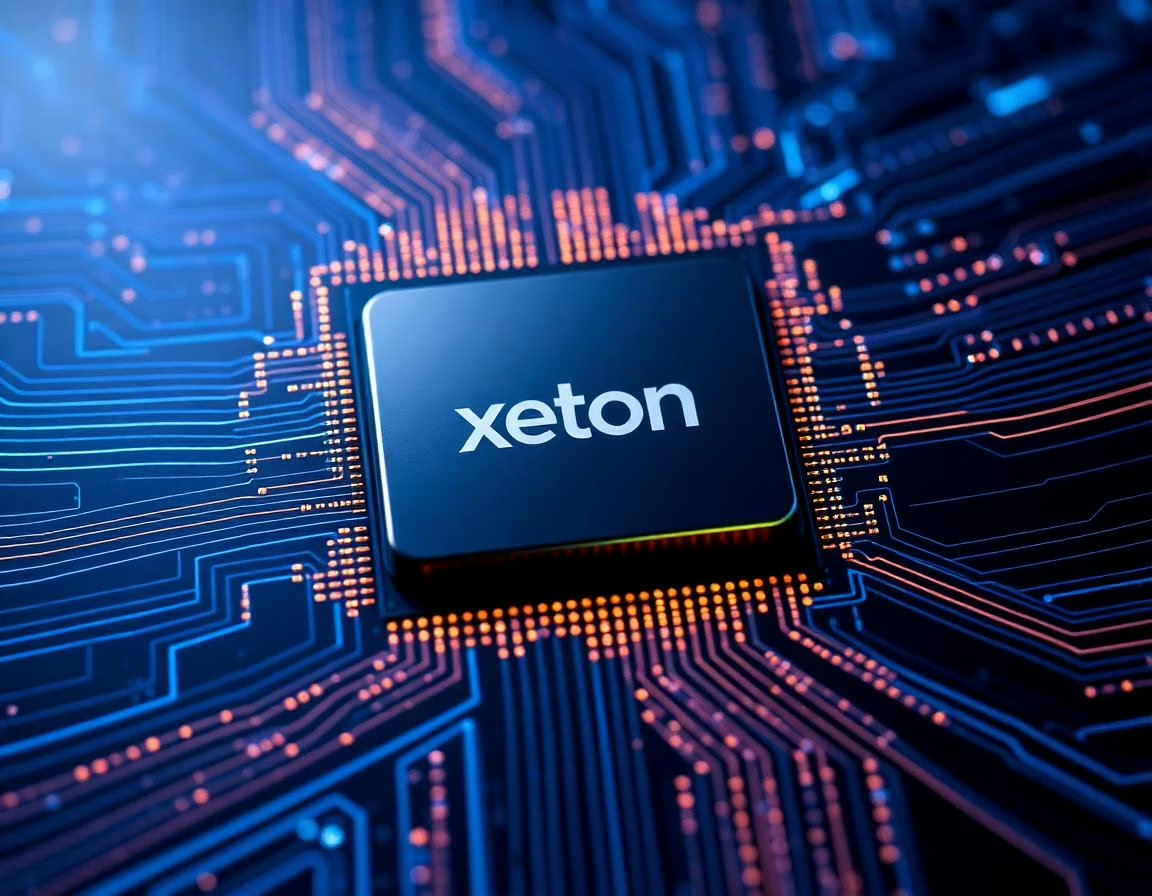
Codenamed “Clearwater Forest,” the Xeon 6+ CPU employs a sophisticated multi-chiplet architecture that integrates 12 compute tiles in a highly compact core arrangement. This design not only enhances processing power but also optimizes efficiency for cloud infrastructures and networking environments.
Intel’s strategy with the Xeon 6+ aligns with the growing demand for AI-driven applications, particularly as networks evolve towards 6G technologies. The deployment of innovative technologies such as high-bandwidth, on-chip fabric 2.5D EMIB links and Foveros Direct 3D die stacking positions the Xeon 6+ to meet the rigorous demands of next-generation networking standards.
Impressive Core Count and Performance
The Xeon 6+ CPUs stand out with an impressive total of 288 cores per unit, doubling the core count of the previous Xeon 6700E series. Each core has been enhanced for improved parallelism, vector throughput, and a larger instruction cache. The ability to support dual-socket platforms allows for a staggering 576 cores, which can handle substantial workloads and complex processing tasks.
Each compute tile is further subdivided into six modules, each housing four Darkmont E-cores. This meticulous design translates to increased efficiency and performance, making the Xeon 6+ ideal for high-demand applications such as edge and on-site AI inference.
Comprehensive I/O Capabilities
The I/O tiles of the Xeon 6+ incorporate two chiplets featuring eight accelerators each. With a rich array of connectivity options, including 48 PCIe Gen 5 lanes and 32 CXL 2.0 lanes, these processors facilitate robust interconnectivity for large clusters of Xeon CPUs. This comprehensive design ensures that the Xeon 6+ can efficiently manage numerous virtual machines and demanding data workloads.
Intel also emphasizes the memory capabilities of the Xeon 6+ CPUs, which can support up to 12 memory channels and DDR5-8000 modules. This memory architecture enhances data transfer speeds, providing significant advantages in performance and responsiveness.
Targeting Network Providers and Data Centers
Intel plans to launch the Xeon 6+ processors in the first half of the year, targeting network providers and data center operators. The company anticipates that cloud providers will leverage these processors to manage dozens, if not hundreds, of virtual machines from a single CPU instance. This capability is particularly beneficial for Radio Access Network (RAN), 5G core, and edge workload deployments.
According to Kevork Kechichian, the executive vice president and general manager of Intel’s Data Center Group, the new architecture supports real-time inference in virtualized RAN deployments. This advancement allows for local processing of data by AI models, reducing the need for data transfer to and from cloud servers, ultimately enhancing efficiency.
Strategic Partnerships for Future Development
Intel is also looking to expand its collaboration with Telefonaktiebolaget LM Ericsson, aiming to co-develop “AI-native 6G solutions.” While specific details remain under wraps, this partnership signifies a commitment to advancing high-performance and energy-efficient computing architectures that cater to both AI and network requirements.
The concept of AI-native 6G encapsulates the integration of intelligent, programmable networks with advanced compute capabilities and real-time sensing. This synergy is expected to yield services that are more responsive, efficient, and capable, fostering a deeper integration between sensing and computational processes.
Conclusion
Intel’s introduction of the Xeon 6+ CPUs marks a significant advancement in the realm of AI-ready networks. With unparalleled core counts and cutting-edge architectural innovations, these processors are set to redefine performance standards in data centers and networking. As the industry pivots towards AI-driven solutions, Intel’s strategic partnerships and technological innovations position it as a leader in the next era of computing.
- The Xeon 6+ CPUs feature 288 cores, doubling the previous model’s capacity.
- Enhanced I/O capabilities allow for robust connectivity and efficient workload management.
- The launch targets network providers and data center operators, optimizing cloud services.
- Intel’s collaboration with Ericsson aims to develop AI-native 6G solutions.
- Real-time inference capabilities enhance data processing efficiency at the edge.
Read more → siliconangle.com



