
Professor Jie Wu delved into the evolution of automated small-molecule synthesis, emphasizing the potential for scalable multistep execution rather than mere isolated reactions. Flow chemistry stands out for its advantages in mixing, heat transfer, safety, and scalability. However, challenges remain in its wider application for automated synthesis, particularly concerning solids handling, prolonged reaction times, and limited compatibility in multistep processes.
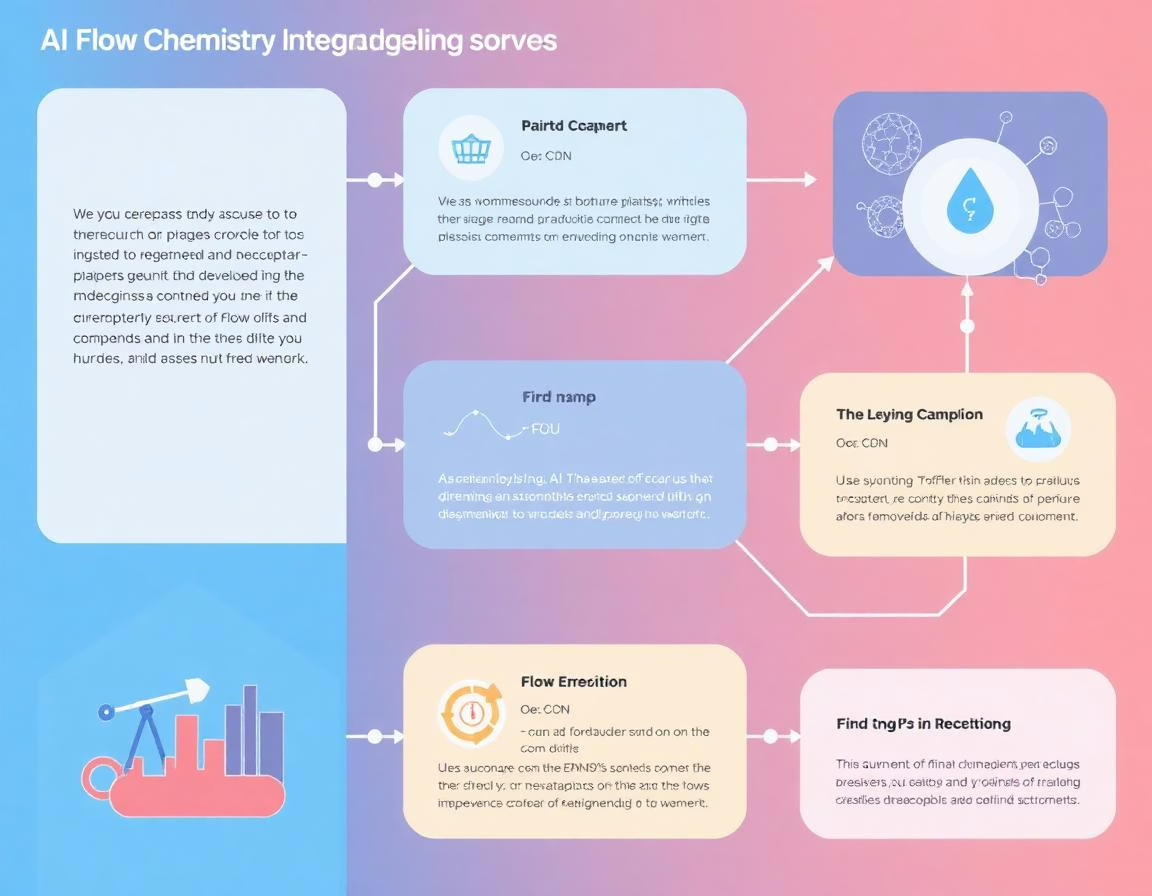
High-Speed Circulation Flow
To tackle these obstacles, Professor Wu introduced high-speed circulation flow as a transformative platform merging batch and continuous processing. This method enhances mixing efficiency, accommodates solids, and improves compatibility with slower reactions. It has shown promise across various reaction types, including photochemical, gas-handling, homogeneous, and heterogeneous reactions, suggesting a more versatile flow toolkit for multistep synthesis.
Importance of Purification in Multistep Chemistry
Wu underscored that mere reaction success is insufficient in multistep chemistry; clean transitions of intermediates between stages are crucial, necessitating integrated purification steps. He proposed two complementary strategies: a universal flow platform aimed at target-oriented synthesis and solid-phase automated synthesis designed for diversity-oriented library construction. The introduction of Chemical Recipe Files provides a standardized method to encode optimized multistep protocols, facilitating reproducible and machine-executable workflows that support both substrate screening and automated synthesis.
AI’s Role in Drug Discovery
The implications of these advancements are particularly significant for AI-driven drug discovery. While AI broadens the scope of design possibilities, the ability to synthesize compounds remains the determining factor for what can be tested. Automated multistep workflows transform digitally proposed molecules into actionable experimental candidates within the Design-Make-Test-Analyze (DMTA) cycle.
Flow Chemistry as a Core Capability
Dr. Kejia Ding shifted the discussion from flow chemistry as a niche tool to its role as an essential capability across medicinal chemistry, process development, and manufacturing. At Viva Biotech, flow chemistry is integrated into a broader chemistry platform that enhances scale-up, facilitates hazardous and gas-handling reactions, and supports photochemistry and electrochemistry, among other applications.
Case Studies Demonstrating Real-World Applications
The case studies presented illustrated the multifaceted value of flow chemistry throughout the development chain. For instance, in the photochemical synthesis of the cyclopenta[b]benzofuran scaffold, flow chemistry enabled a compact and efficient setup tailored for medicinal chemistry. Viva Biotech optimized a previously published method, achieving a workflow capable of producing over 20 grams per day of the desired scaffold.
In another project focused on difluoromethyl chemistry, the team revisited the synthesis of a difluoromethyl sulfonyl chloride-related reagent due to sourcing and cost challenges. Flow processing offered a safer and more efficient alternative for a route involving chlorodifluoromethane under heated conditions, allowing for the production of 80 grams per day of crude material.
Continuous Flow in Manufacturing
Langhua Pharma, a subsidiary of Viva Biotech, highlighted the achievements of a multi-step continuous-flow Curtius rearrangement performed under challenging conditions. This process, which involved handling sodium azide and required tight timelines, benefited from flow chemistry’s ability to provide a safer, scalable solution. The development team successfully transitioned from initial process development to pilot demonstration, delivering over 1,000 kilograms within a two-month timeframe.
The Need for Flexible Integration
Dr. Ding recognized that even in highly automated areas like peptide synthesis, complex programs need the flexible integration of various platforms and expert input. This reinforces a crucial theme from the discussion: the future of drug development does not lie in isolated technologies but in the synergistic combination of multiple innovations into comprehensive, end-to-end systems.
Bridging Design and Execution
A key takeaway from the discussion is that AI achieves its maximum potential when closely integrated with experimental systems capable of synthesizing, testing, refining, and scaling molecules in the laboratory. Flow chemistry and automation are not merely standalone advancements; they are integral components of a comprehensive operational model for drug discovery.
Through its integrated platform, Viva Biotech is actively bridging the gap between molecular design and practical execution, connecting discovery capabilities with synthesis, development, and manufacturing expertise. This holistic approach supports partners from the initial stages of research all the way to product delivery.
Conclusion
The intersection of AI and flow chemistry represents a transformative leap in drug development. By enhancing scalability and streamlining workflows, these technologies not only accelerate the pace of innovation but also expand the horizons of what is possible in pharmaceutical research. The future lies in the seamless integration of these capabilities, enabling a more efficient and effective path from concept to clinical application.
- Key Takeaways:
- High-speed circulation flow enhances multistep synthesis capabilities.
- Integrated purification is vital for successful multistep chemistry.
- AI’s impact in drug discovery is maximized when coupled with robust synthesis systems.
- Flow chemistry serves as a core capability across various stages of drug development.
- Collaborative integration of technologies will drive the future of life sciences.
Read more → www.manilatimes.net



