
Microfluidic devices have unlocked a realm of possibilities in the biotech industry, offering precise control over tiny volumes of fluids for various applications, from cell cultivation to disease diagnosis. These devices, with channels as small as tens to hundreds of micrometers, provide unparalleled efficiency, repeatability, and control over spatiotemporal dynamics. The ability to integrate multiple analytical processes into a single chip, known as a biochip or Lab-On-a-Chip (LOC), has revolutionized how experiments are conducted in the lab.
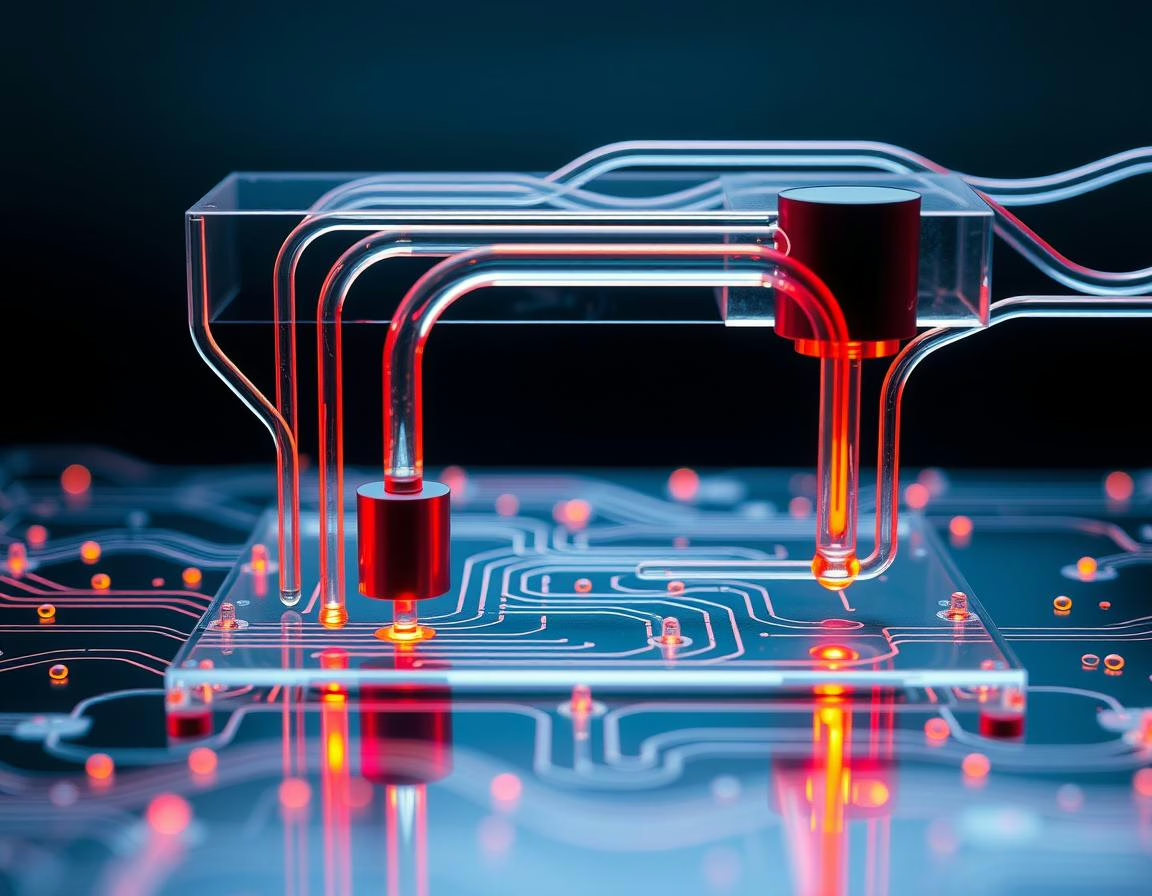
Unleashing the Power of Microfluidics
Microfluidic systems have found extensive use in various biophysical tasks, including cell separation, tissue engineering, and point-of-care diagnostics. The versatility of microfluidic devices lies in their ability to perform multiple experiments simultaneously within a single device, saving time and resources. With the advent of microfluidics, tasks that were once labor-intensive and time-consuming can now be automated, accelerating the pace of research and development in the biotech sector.
Passive Flow Control: Harnessing Natural Forces
Passive flow control methods in microfluidics leverage natural forces such as gravity, capillary action, surface tension, vacuum suction, osmosis, and pressure gradients to drive fluid through microchannels. These methods, known for their simplicity and portability, are ideal for low-cost and portable microfluidic applications. Gravity-driven systems, for instance, offer a straightforward way to create flow rates in microfluidic devices, albeit with limitations in continuous flow generation.
Capillary Action: The Art of Autonomy
Capillary action, driven by surface tension and wetting properties, allows fluids to move autonomously within porous materials. Capillary pumps have been instrumental in applications such as protein detection and chemical analysis. By harnessing capillary forces, researchers have developed innovative microfluidic systems that enable rapid analyte detection and precise control over flow rates, paving the way for point-of-care diagnostics and biochemical assays.
Surface Tension: A Force to Reckon With
Surface tension-driven microfluidic systems regulate flow rates by exploiting the surface tension of liquids. These systems, characterized by stable flow rates and passive filling mechanisms, have been instrumental in studying pancreatic islets, droplet generation, and cell culture platforms. By utilizing surface tension as a driving force, researchers have developed sophisticated microfluidic devices for various biological and chemical analyses.
Vacuum-Driven Systems: Simplicity Meets Efficiency
Vacuum-driven microfluidic systems, leveraging the gas permeability of materials like PDMS, offer a simple yet effective way to drive fluid through microchannels. These systems have found applications in sample loading, mixing, cell separation, and culture, showcasing the ease of use and versatility of passive pumping techniques. By combining vacuum-driven methods with other passive mechanisms, researchers have developed power-free microfluidic chips for sensitive assays and diagnostics.
Osmosis: The Equilibrium Enigma
Osmosis-driven flow in microfluidics relies on the movement of molecules through a semipermeable membrane from regions of low to high solute concentration. While osmotic pumps offer a unique way to generate fluid flow, their complexity and dependence on solute concentrations present challenges in achieving stable and accurate flow rates. Despite these limitations, osmotic-driven systems have shown promise in sustained fluid delivery applications.
Active (Mechanical) Systems: Precision at Play
Active pumping methods in microfluidics, powered by syringe pumps, micropumps, valves, and electromagnetic forces, provide precise, non-pulsatile control over fluid flow. These systems, though more complex than passive methods, offer unparalleled accuracy in continuous-flow control, making them ideal for multi-stage experiments and high-throughput applications. The integration of mechanical elements into microfluidic chips has expanded the possibilities of self-contained microfluidic systems, enabling advanced research in biotechnology.
Bridging the Gap: Integrating Multifunctional Tools
The synergy between microfluidic platforms and analytical tools like scanning probe microscopy opens new avenues for studying cellular responses and local mechanical properties with high spatial resolution. By combining pressure- and electroosmotic-driven forces, researchers can achieve nano-scale 3D printing, cell translocation, and dynamic analyses of living cells, revolutionizing our understanding of biological processes at the nanoscale.
In conclusion, the evolution of microfluidic pumping techniques has transformed the landscape of biotechnology, offering unprecedented control and automation in experimental workflows. From passive flow control methods harnessing natural forces to active mechanical systems enabling precision control, each innovation in microfluidics brings us closer to unlocking the full potential of biotechnological applications. As researchers continue to push the boundaries of microfluidic technologies, we can expect even more groundbreaking discoveries and advancements in the field of biotechnology.
Key Takeaways:
- Microfluidic devices empower precise control over tiny volumes of fluids, revolutionizing biotech applications.
- Passive flow control methods leverage natural forces like gravity, capillary action, and surface tension for simplicity and portability.
- Active pumping methods offer precise, non-pulsatile control over fluid flow, enabling multi-stage experiments and high-throughput applications.
- The integration of multifunctional tools like scanning probe microscopy enhances research capabilities in studying cellular responses and local mechanical properties.
Tags: biosensors, regulatory, tissue engineering, cell culture
Read more on pmc.ncbi.nlm.nih.gov



