
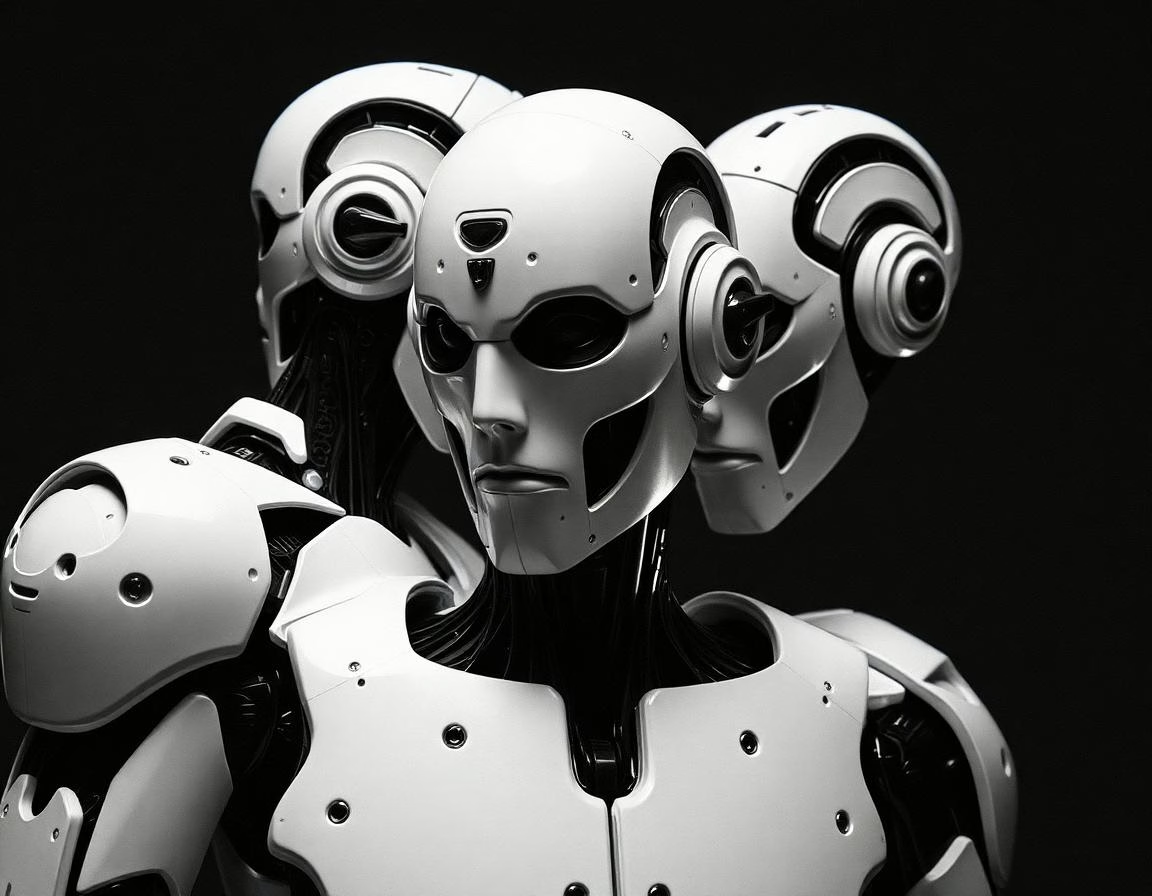
On a brisk Sunday morning in Beijing, an exciting spectacle unfolded as over 100 humanoid robots took to the starting line of the city’s half marathon. The event showcased remarkable advancements in robotic technology, with machines that not only demonstrated speed but also a newfound autonomy.
A Shift in Focus
After the initial excitement of last year’s inaugural humanoid robot marathon, the 2026 edition brought a sharper focus on genuine autonomy. Organizers implemented new rules, stipulating that robots unable to navigate independently would face a time penalty. This strategy encouraged competitors to push their machines towards self-sufficiency, resulting in nearly 40 percent of participants completing the race autonomously.
Engineering Innovations
Chinese engineers prioritized enhancing perception and intelligence over mere physical prowess. The competition highlighted the significance of advanced artificial intelligence, which is now at the heart of robotic development. While last year’s race featured a variety of designs, this year’s participants largely operated on a few standard platforms. Teams primarily utilized models from well-known manufacturers like Unitree and UBTECH’s Tien Kung, with the real contest emerging in the optimization algorithms powering these robots.
The Race Dynamics
Leading the pack was an impressive Honor robot, characterized by its striking red-and-black appearance and unique gait. It moved with a distinctive V-shaped leg formation, swaying its upper body rhythmically with each stride. In contrast, a competitor from Tien Kung showcased a running style reminiscent of professional athletes, with an upright posture and high arm carriage.
Honor’s robots dominated the leaderboard, with one model crossing the finish line first under operator supervision and another achieving true autonomous navigation. Clocking in at an astounding 50 minutes and 26 seconds, the winning robot not only claimed victory but also shattered the previous human record by more than six minutes. According to engineer Du Xiaodi, this achievement was a result of training that emulated elite human runners.
Notable Performances
The competition was fierce, with Honor robots claiming both the second and third positions. One of them, however, encountered a mishap, colliding with a safety barrier due to its momentum. Meanwhile, Tien Kung’s Ultra robot, equipped with protective features, impressed spectators with a dramatic finish, edging out a rival in the last 50 meters despite not cracking the top three.
This marked a significant improvement for Tien Kung, which had previously finished the 2025 race in a staggering 2 hours and 40 minutes. Engineer Zhao Wen attributed the advancements to smarter algorithms and integrated systems, allowing for dynamic adjustments in stride frequency and length.
Global Participation and Impact
The event attracted global interest, featuring teams from countries such as Germany, France, Portugal, and Brazil. The international audience witnessed firsthand the rapid progression of Chinese robotics technology. Earlier in the year, German Chancellor Friedrich Merz had also recognized this advancement during a visit to a robotics facility, where humanoid robots showcased their capabilities.
The half marathon course itself posed several challenges, with diverse terrain types, steep inclines, and complex obstacles. These elements tested the robots’ agility and energy efficiency. According to researcher Zhao Mingguo, the race served as a crucial evaluation of a robot’s mobility and adaptability.
Robotics Beyond Racing
While the race concluded, the journey for humanoid robots is only beginning. There is a growing consensus that the purpose of robotics should extend beyond mere labor replacement; rather, robots should undertake roles that are dangerous or undesirable for humans, such as in rescue operations or remote tasks.
Although AgiBot, another prominent Chinese robotics firm, opted out of the marathon, it demonstrated its robots’ capabilities in a factory setting, showcasing their proficiency in assembly line tasks. This reflects a broader initiative in China to integrate AI into manufacturing processes.
In Shenzhen, a tech hub, humanoid robots are already employed in various roles, from traffic management to household assistance. With the Chinese government promoting embodied intelligence as a key industry in its five-year plan, the future of humanoid robotics appears promising. Projections suggest that the market for these robots could reach approximately 870 billion yuan (about 127.6 billion U.S. dollars) by 2030.
The Vision Ahead
As noted by Liang Liang of the Chinese Institute of Electronics, the aim of the race transcends mere competition. It seeks to identify exceptional engineering teams and stimulate technological rivalry, ultimately paving the way for market-ready innovations.
The remarkable feats demonstrated at the Beijing half marathon signify a pivotal moment in the evolution of humanoid robotics. As these machines continue to break records and redefine capabilities, the integration of robotics into everyday life becomes increasingly feasible.
- Humanoid robots showcased significant advancements in autonomy and performance.
- The competition emphasized the importance of AI-driven intelligence in robotics.
- Robots took on a challenging course, testing their agility and energy efficiency.
- The event attracted global participants, highlighting international interest in Chinese robotics.
- The future of humanoid robotics looks promising, with projections for substantial market growth.
Read more → www.independent.co.ug



