
Chinese hamster ovary (CHO) cells play a pivotal role in the production of glycoprotein therapeutics, where N-linked glycans significantly impact the efficacy and safety of these biotherapeutics. Manipulating protein glycosylation to enhance product quality often involves intricate cell and process engineering guided by mathematical models. However, the unique glycosylation reaction networks considered in various studies can be tailored around specific cell lines and products. To address this, a groundbreaking study has reconstructed a comprehensive glycosylation reaction network named CHOGlycoNET, drawing from 200 glycan datasets of recombinant and native proteins from diverse CHO cell lines. This innovative network sheds light on the distribution of key enzymes in the Golgi apparatus and identifies crucial reactions using advanced machine learning techniques. CHOGlycoNET promises to expedite the development of glycosylation models and forecast the impact of glycoengineering strategies, offering a powerful tool for the biotech industry.
Unraveling the Complexity of Glycosylation Networks
The majority of biotherapeutics are manufactured using CHO cells due to their efficiency in producing recombinant proteins. The efficacy of glycoengineering strategies hinges on understanding the underlying glycosylation reaction network of the host cell line. Various studies have proposed vastly different reaction networks, ranging from 25 to 40,000 reactions depending on the complexity of the glycoprotein. Constructing a cell-specific reaction network is a laborious process, prompting the development of algorithms based on experimental glycomic data to automate this task. The competition among glycosyltransferases for the same substrates attached to glycoproteins leads to a disproportionate increase in the number of reactions as glycan complexity grows. However, not all theoretically possible reactions are biologically relevant, emphasizing the need for precise network reconstruction.
The Birth of CHOGlycoNET
In a pioneering effort, CHOGlycoNET was formulated by amalgamating 200 glycan datasets from multiple labs, encompassing a diverse array of glycoproteins and HCPs from various CHO cell lines. Leveraging mass spectrometry for glycan identification ensured dataset uniformity. CHOGlycoNET strikes a delicate balance between network size and inclusivity of latent reactions, crucial for capturing the intricacies of glycan biosynthesis. Noteworthy is the distinct network complexity observed between CHO–S and CHO–K1 cells, underscoring the importance of cell line specificity in glycosylation dynamics. By estimating enzyme distribution and identifying critical reactions using cutting-edge techniques, CHOGlycoNET stands at the forefront of glycoengineering research, offering a holistic view of protein glycosylation in CHO cells.
Insights into Glycan Biosynthesis
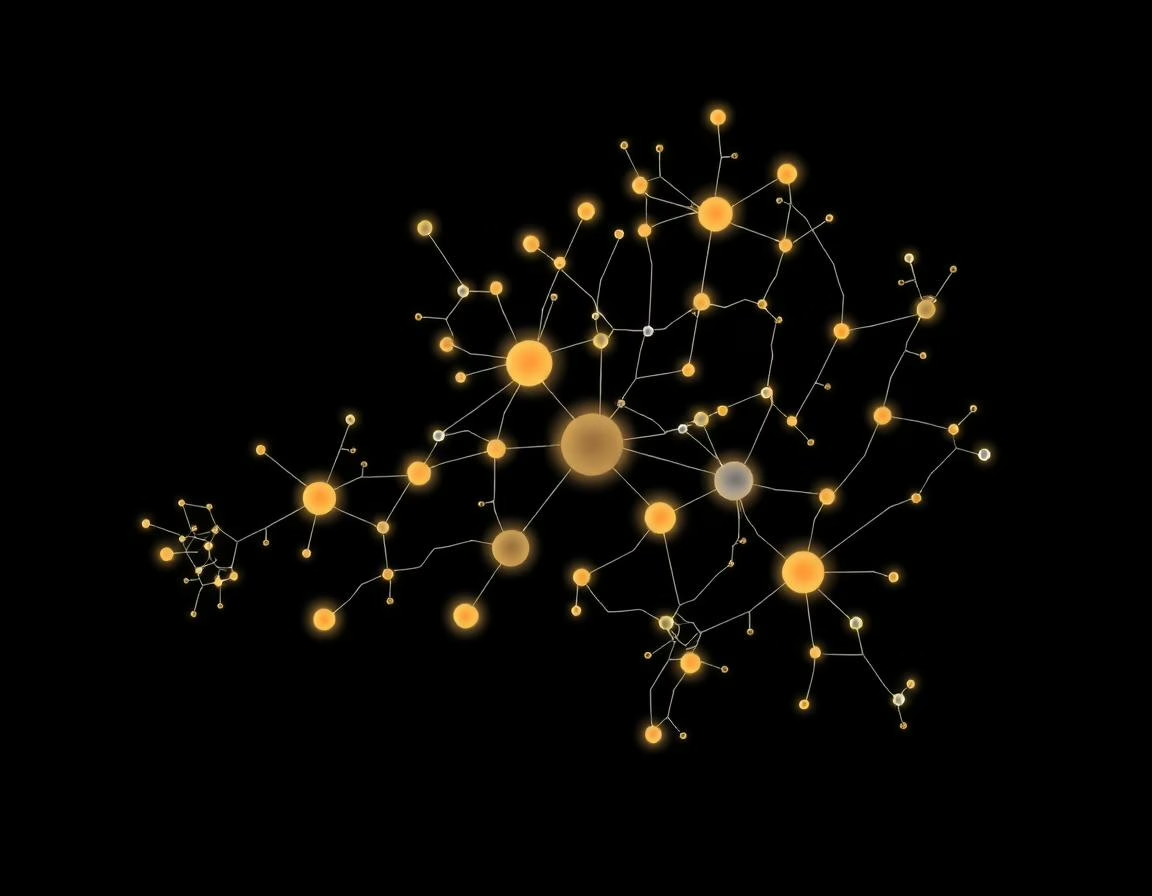
CHOGlycoNET boasts a repertoire of 597 reactions and 326 oligosaccharides, meticulously curated to encompass experimentally observed glycan structures with minimal additional intermediates. The network delineates the diverse steps in glycan biosynthesis, shedding light on the roles of key enzymes such as b4GalT and a3SiaT in catalyzing glycosylation reactions. Interestingly, the network complexity differs between CHO–S and CHO–K1 cells, reflecting variations in glycosylation machinery and glycoprotein microheterogeneity. Enzyme-specific distributions along the Golgi length unveil sequential glycan maturation patterns, with enzymes like a3SiaT and b4GalT playing pivotal roles across different glycan complexity levels. The network structure aligns closely with experimental and computational findings, offering a roadmap to decipher the glycosylation landscape in CHO cells.
Data Harmonization and Network Contributions
The amalgamation of diverse glycomic datasets underscores the robustness of CHOGlycoNET, with each dataset contributing distinct reactions towards network construction. Notably, detailed analyses of gene knockout effects and site-specific glycomics yield expansive sub-reaction networks, enriching the global CHOGlycoNET. The dataset diversity not only enriches the network but also unveils cell line-specific glycosylation nuances, highlighting the intricate interplay of enzymes in glycan biosynthesis. By encompassing a wide array of experimental methodologies, CHOGlycoNET encapsulates the multifaceted nature of protein glycosylation, offering a comprehensive view of glycan biosynthetic pathways in CHO cells.
Future Implications and Conclusion
CHOGlycoNET heralds a new era in glycoengineering by providing a robust platform for designing tailored glycosylation strategies and accelerating model development. The network’s ability to predict the effects of genetic and metabolic perturbations on glycosylation paves the way for precision glycoengineering in biopharmaceutical production. As a versatile tool for simulating glycosylation models, CHOGlycoNET holds immense potential in optimizing glycoprotein quality and efficacy. By unraveling the complexities of protein glycosylation in CHO cells, CHOGlycoNET emerges as a cornerstone in advancing biotechnological innovations.
Key Takeaways:
– CHOGlycoNET is a comprehensive glycosylation reaction network derived from 200 glycan datasets of CHO cells, offering insights into protein glycosylation dynamics.
– The network unveils enzyme distributions in the Golgi apparatus and identifies critical reactions, aiding in the development of glycoengineering strategies.
– Differences in network complexity between CHO–S and CHO–K1 cells underscore cell line-specific glycosylation patterns.
– Data harmonization from diverse glycomic datasets enriches CHOGlycoNET, providing a holistic view of glycan biosynthesis in CHO cells.
– CHOGlycoNET’s predictive capabilities pave the way for precision glycoengineering and accelerated model development in biopharmaceutical production.
Tags: chromatography, cell culture, mass spectrometry, downstream
Read more on pmc.ncbi.nlm.nih.gov



