
In the realm of virology, the intricate structures of bacteriophages have fascinated scientists for decades. Among these viral entities, tailed phages stand out as genome delivery machines that have honed their efficiency over billions of years of evolution. In particular, Siphophages from the P335 and 936 families have captured the interest of researchers due to their infections of the Gram-positive bacterium Lactococcus lactis using receptor-binding proteins anchored to the host adsorption apparatus. Recent studies have delved into the unique adsorption strategies employed by phages of these families, hinting at potential differences in their infection mechanisms. One such phage, TP901-1, belonging to the P335 species, has been the focus of electron microscopy reconstructions, shedding light on its structural intricacies and providing insights into the evolutionary relationships shared among tailed phages.
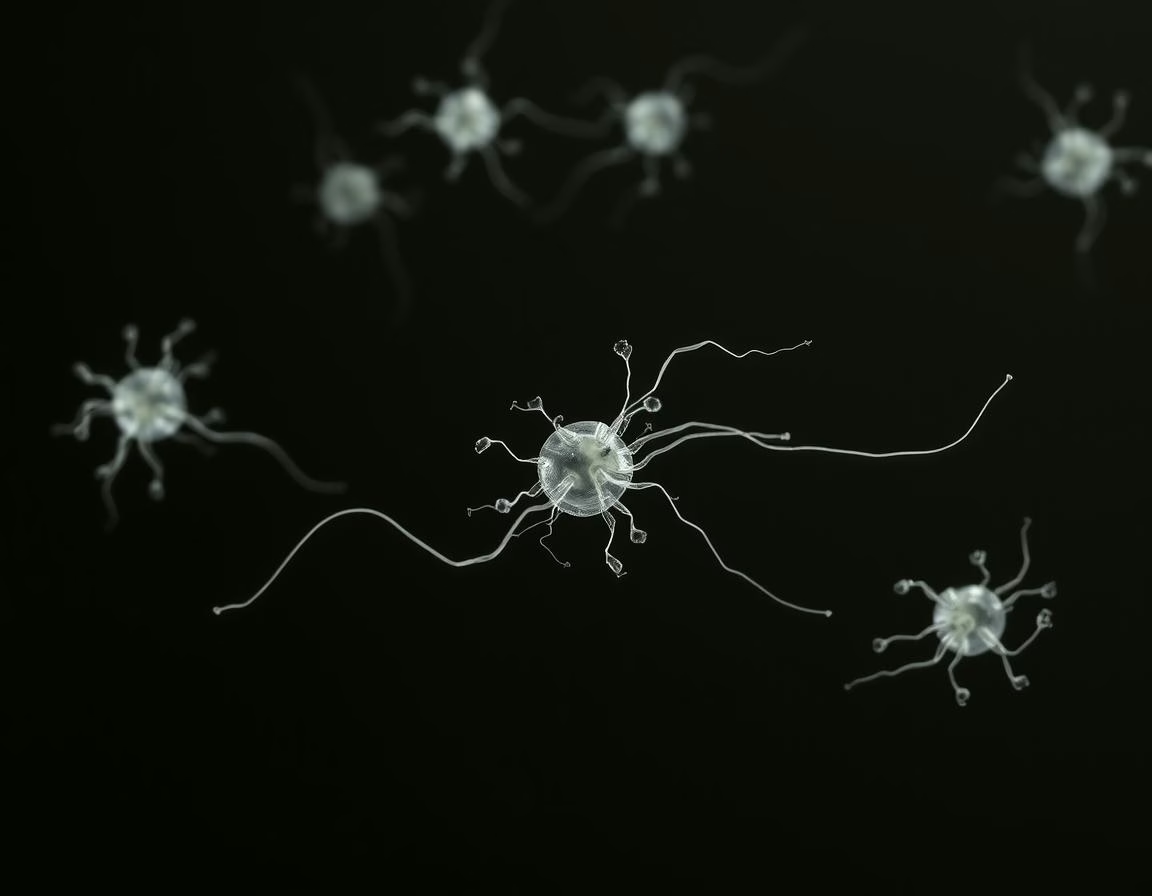
Bacteriophages, specifically those of the order Caudovirales, are remarkable nanomachines equipped with tail appendages that play a crucial role in recognizing and delivering their genetic payload to host cells with remarkable precision. Classified into families based on tail morphology, including Myoviridae, Podoviridae, and Siphoviridae, these phages exhibit a diverse array of structures tailored to their infection strategies. Notably, Siphoviridae tails, characterized by long noncontractile tubes, possess a conserved architecture comprising major tail protein (MTP) rings and a tape measure protein (TMP) that determines tail length. The distal tail end features the host adsorption apparatus, crucial for initiating infection in Gram-positive bacterial hosts.
Recent investigations into phage-host interactions have highlighted the distinct baseplate architectures of phages targeting Lactococcus lactis, such as p2 and TP901-1. These studies have revealed the diverse strategies employed by these phages to initiate infection, with implications for host adhesion and the role of calcium ions in this process. Notably, the TP901-1 baseplate showcases receptor-binding proteins poised for host interaction, underscoring the importance of structural adaptations in phage evolution. Insights from in vivo infection experiments have further corroborated these findings, emphasizing the role of calcium ions in host adhesion among specific phage species.
Despite the challenges posed by the flexible nature of Siphoviridae tails, recent electron microscopy reconstructions of TP901-1 have provided valuable insights into the organization of this phage. By employing single-particle protocols tailored for characterizing the complex tail structure, researchers have unveiled the intricate details of TP901-1 virions, including the composition of the capsid, connector, tail, and baseplate. The comprehensive reconstructions have facilitated the generation of pseudoatomic models, shedding light on the structural conservation of canonical phage proteins and their evolutionary connections. Furthermore, the correlation between host adsorption apparatus architectures and infection strategies has emerged as a key theme in deciphering phage-host interactions.
The meticulous structural analyses of TP901-1 have unraveled the secrets of its capsid, revealing a robust container housing the viral genome within a precisely organized shell. The conservation of major capsid protein (MCP) structures across tailed phages underscores the evolutionary relationships shared by these viral entities. By leveraging bioinformatics tools and sequence analyses, researchers have gained insights into the molecular mechanisms underpinning TP901-1 assembly and maturation, drawing parallels to well-characterized phage systems like P22.
The connector region of TP901-1 plays a pivotal role in bridging the capsid and tail components, ensuring seamless coordination for genome delivery. Through detailed reconstructions and fitting of structural models, researchers have elucidated the organization of the portal protein, head completion proteins, and tail terminator within the connector. The intricate interactions between these components underscore the precision and complexity of phage machinery involved in orchestrating genome ejection and infection processes.
Delving deeper into the tail structure of TP901-1, researchers have delineated the organization of MTP rings, TMP, and the central channel critical for DNA transit during infection. The detailed reconstructions have provided a roadmap for understanding how the tail components collaborate to facilitate genome delivery with remarkable efficacy. By comparing the tail architecture of TP901-1 with related phages like SPP1, researchers have uncovered conserved features essential for tail function and assembly.
The baseplate, as the command center for infectivity, holds the key to host recognition and attachment, setting the stage for infection initiation. Integrating crystallographic data with electron microscopy reconstructions, researchers have unraveled the intricate organization of the TP901-1 baseplate, showcasing a symphony of proteins orchestrating host interactions. The detailed mapping of receptor-binding proteins, tail fibers, and associated structures has provided a comprehensive view of the molecular ballet underlying phage-host interactions.
In conclusion, the structural elucidation of Lactococcal Phage TP901-1 through electron microscopy has unveiled a tapestry of molecular interactions and architectural marvels that underpin its infectivity. By piecing together the puzzle of TP901-1 structure, researchers have not only expanded our understanding of phage biology but also opened new avenues for exploring the evolutionary connections and functional adaptations of these viral entities. The intricate dance between phages and their hosts, as revealed through detailed structural analyses, serves as a testament to the elegance and complexity of nature’s molecular machinery.
Key Takeaways:
– Electron microscopy reconstructions of TP901-1 have unveiled the structural intricacies of this Siphoviridae phage.
– The baseplate architectures of phages targeting Lactococcus lactis exhibit diverse strategies for host adhesion and initiation of infection.
– Structural conservation of canonical phage proteins underscores evolutionary connections among tailed phages.
– The tail architecture of TP901-1 showcases the precision and complexity of components involved in genome delivery.
– The molecular ballet orchestrated by the TP901-1 baseplate highlights the critical role of host recognition and attachment in phage infectivity.
Tags: bioinformatics, secretion, upstream
Read more on pmc.ncbi.nlm.nih.gov