
In the pursuit of unraveling the mysteries of life’s origins, scientists have embarked on a journey spanning centuries, attempting to recreate organic molecules from inorganic sources. This quest has led to a deeper understanding of life’s building blocks, culminating in the ambitious endeavor of constructing a synthetic cell from scratch. However, this monumental task requires a comprehensive, multidisciplinary approach that integrates various facets of life into a cohesive whole.
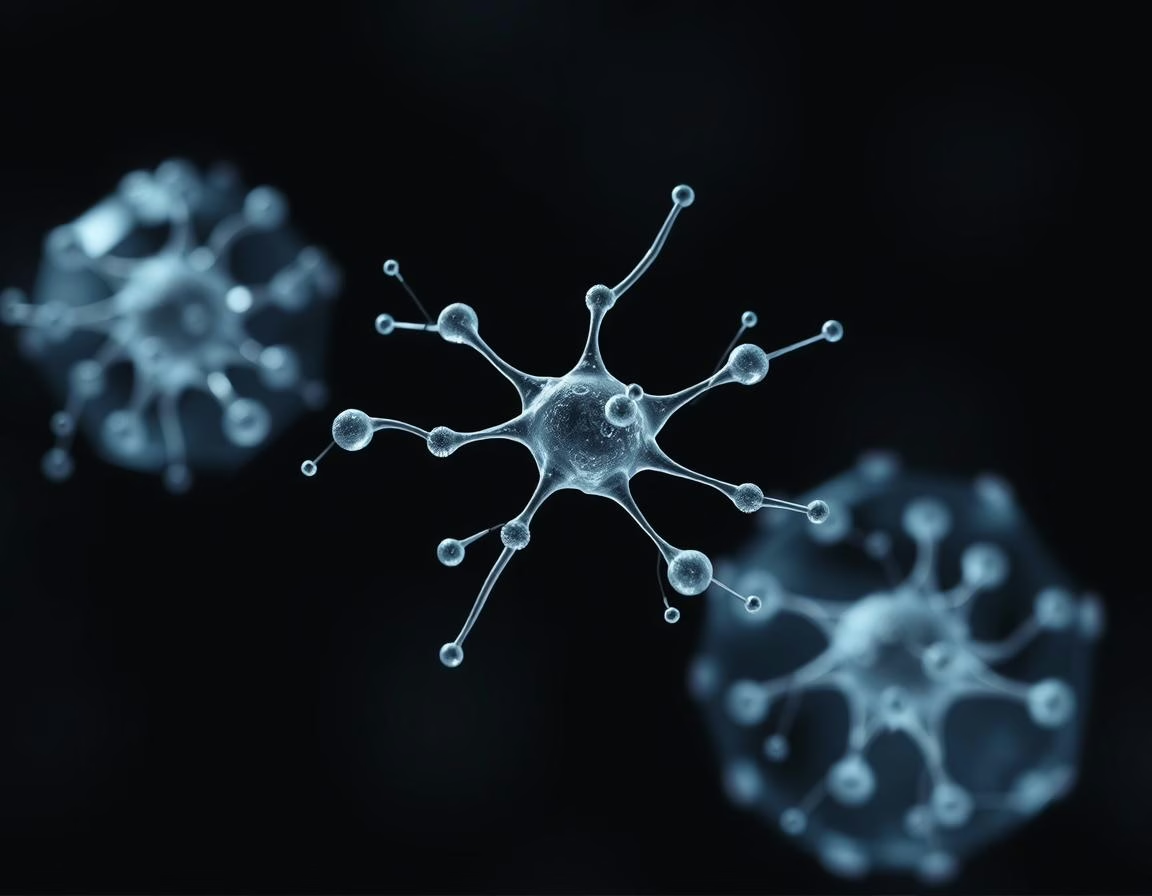
In recent decades, the scientific community has witnessed a surge in research efforts focused on synthetic cell construction. While previous studies have often concentrated on individual components of life, the realization of an entire synthetic cell demands a holistic perspective and collaborative synergy across disciplines.
Noteworthy initiatives such as the European Synthetic Cell Initiative and Build-a-Cell in the USA have laid the groundwork for regional collaborations in synthetic cell research. Building on this momentum, the Asian Synthetic Cell Initiative (SynCell Asia) was inaugurated during the Asian Synthetic Biology Association (ASBA) Workshop on Biofoundry and Synthetic Cell in October 2023. The inaugural SynCell Asia workshop convened in April 2024 in Shenzhen, China, uniting researchers from 25 institutions across Asia.
The workshop’s agenda encompassed four pivotal sessions: SynCell Membrane and Replication, SynCell Transcription and Translation, SynCell Metabolism, and SynCell Technology and Application. Each session delved into crucial aspects of synthetic cell research, fostering in-depth discussions and knowledge exchange among participants.
Unveiling the Foundations of Synthetic Cell Construction
Membrane compartmentalization emerged as a cornerstone in synthetic cell development, safeguarding cellular functions and mediating responses to the external milieu. The workshop’s inaugural session, ‘SynCell Membrane and Replication,’ elucidated strategies for fabricating resilient and adaptable artificial cell membranes essential for maintaining structural integrity and enabling replication.
Exploration into liposomes as versatile platforms for integrating cellular functions showcased advancements in enhancing their robustness and functionality. Additionally, discussions on non-liposome systems, including artificial membraneless organelles, underscored the potential for spatial-temporal control of intracellular biochemical reactions and signal transduction.
Navigating the Complexities of Transcription and Translation
Efficient protein synthesis lies at the heart of synthetic cell functionality, necessitating the reconstitution of transcription and translation processes from their fundamental components. The session ‘SynCell Transcription and Translation’ delved into the challenges associated with constructing artificial ribosomes—a critical component in the DNA-RNA-protein machinery. Despite the complexity of ribosomal structures, researchers remain optimistic about achieving a self-sustaining PURE system within the next decade.
Empowering Synthetic Cells with Metabolic Capabilities
Metabolism serves as a cornerstone in facilitating the regeneration of macromolecules, energy provision, and redox balance critical for synthetic cell sustenance. Efforts to engineer artificial metabolic pathways have focused on enhancing enzymatic efficiency and metabolic regulation. Challenges persist in precisely regulating enzyme expression levels and dynamically controlling metabolic cascades in synthetic cells amidst the disparity between living and artificial cell conditions.
Applications, Implications, and Future Directions
Synthetic cell research boasts far-reaching applications across industry and scientific domains, offering insights into complex biological systems and potential extraterrestrial life forms. The ‘build to understand’ paradigm underscores its utility in unraveling life’s fundamental questions and driving technological innovations akin to the Human Genome Project’s impact on next-generation sequencing methods.
Standardization emerges as a pivotal consideration in synthetic cell research, balancing the need for uniformity with the imperative for innovation. While challenges in data availability and synthetic cell understanding impede universal standardization, initiatives such as cell-free protein expression systems pave the way for initial standardization efforts.
Navigating Biosafety and Regulatory Frontiers
Amidst discussions on biosafety concerns and regulatory frameworks, attendees underscored the controlled nature of synthetic cells constructed from the ground up, diminishing immediate safety risks. Synthetic cells hold promise as tools for studying DNA transfer mechanisms, addressing biomedical challenges like drug delivery, and complying with existing regulatory frameworks for toxic compounds and unknown substances.
Pan-Asian Synergy for SynCell Advancement
The Pan-Asian Strategic deliberations emphasized the significance of fostering SynCell communities through collaborative funding, educational initiatives, and interdisciplinary engagement. Promoting global cooperation, nurturing young talents through educational programs, and standardizing synthetic cell concepts and procedures emerged as key strategies for advancing SynCell research.
As the inaugural SynCell Asia workshop concluded, it set the stage for enhanced research activities, fostering collaborative partnerships, and propelling synthetic cell research into a new era of innovation and discovery.
Key Takeaways:
– Synthetic cell research holds immense potential for advancing our understanding of life’s fundamental principles and driving technological innovations.
– Collaboration and standardization are essential for accelerating synthetic cell research and ensuring its safe and ethical advancement.
– Regional initiatives like SynCell Asia are instrumental in fostering interdisciplinary collaboration, knowledge exchange, and research advancements in synthetic biology.
– Funding support, global cooperation, and nurturing young talents are pivotal for propelling synthetic cell research towards transformative breakthroughs.
Tags: drug delivery, synthetic biology, regulatory
Read more on pmc.ncbi.nlm.nih.gov



