
Born out of China’s elite Tsinghua University in August 2023, Robotera is the breakout humanoid robotics startup turning heads worldwide. Armed with bleeding-edge AI, precision mechatronics, and deep robotics R&D straight from one of the nation’s most prestigious tech powerhouses, this spinoff has rocketed from lab project to global contender—fast becoming one of the hottest names in the humanoid revolution.
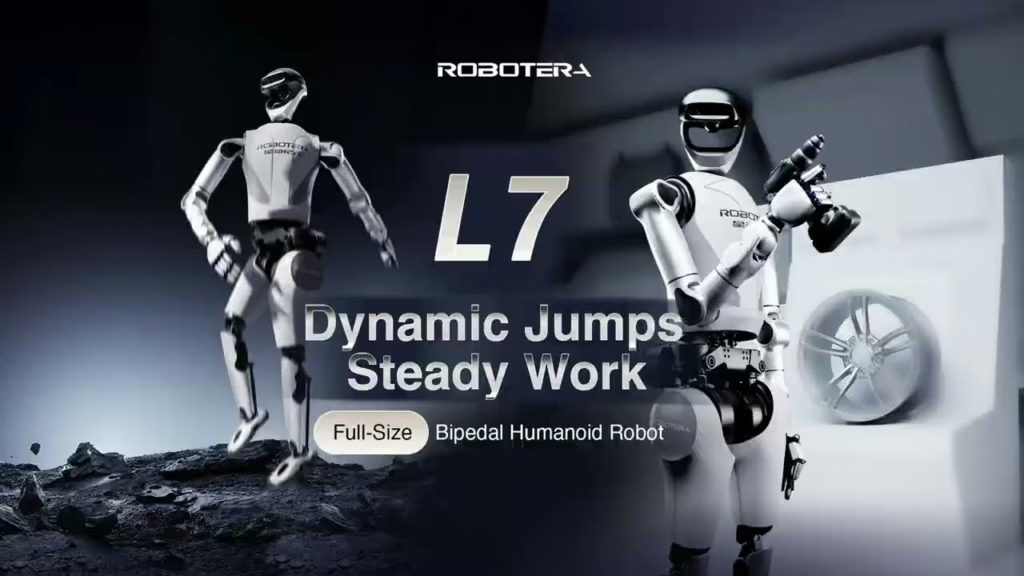
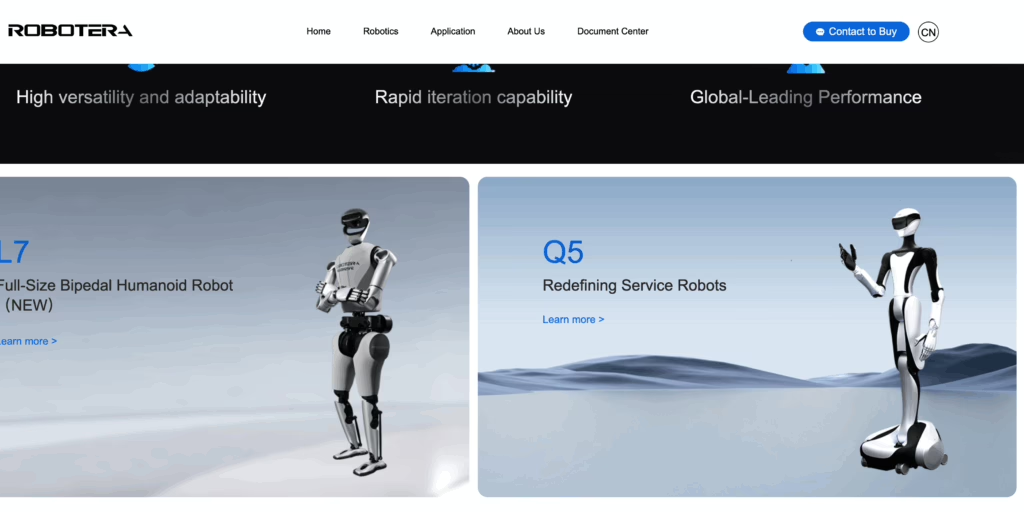
Its flagship product, the L7, is a full-size bipedal humanoid robot engineered for robust mobility, high payload handling, and fine-grained manipulation tasks. Combining high-torque actuators, precise joint control, and advanced perception systems, the L7 is designed to operate in both structured industrial settings and dynamic real-world environments.
Funding Momentum and Strategic Backing
Robotera has captured significant investor attention, securing USD 111 million in total funding since inception. The company’s Series A round in mid-2025 raised CNY 500 million (~USD 70 million), led by CDH Investments and Haier Capital, two heavyweight players in China’s deep tech and industrial manufacturing investment landscape. Earlier, in early 2024, Robotera closed a pre-Series A worth CNY 300 million (~USD 42 million), with participation from Crystal Stream Capital, Vision Plus Capital, Alibaba Group, and other notable investors. This investor mix not only provides capital but also strategic links into manufacturing, AI ecosystems, and global market distribution channels.
Scaling Up: Products and Market Reach
Within just two years, Robotera has delivered over 200 robots worldwide, with more than 50% of orders from overseas clients—a rare feat for a young robotics company. This early international traction signals competitive technology readiness and market appeal. The company’s product portfolio spans:
- Q5 – a wheeled humanoid service robot optimized for retail, hospitality, and customer-facing roles.
- STAR 1 – a next-generation full-sized bipedal industrial humanoid robot currently in development, aimed at heavy-duty industrial tasks.
- ERA-42 AI Model – a specialized AI system for high-precision, multi-step task execution.
- XHAND1 – a dexterous five-finger robotic hand with humanlike articulation for advanced manipulation.
The STAR 1 platform, targeted for integration into China’s industrial supply chain by 2027, features 55 degrees of freedom, joint torque up to 400 N·m, and joint speeds of 25 rad/s, positioning it for complex, heavy-load industrial workflows. While pricing and mass-production timelines remain undisclosed, its development aligns with Beijing’s broader strategy to deploy humanoid robots in manufacturing and logistics at scale within the decade.
AI-Driven End-to-End Learning
Robotera’s core R&D focus extends beyond hardware. The company is building an end-to-end learning framework to unify natural language processing, computer vision, and autonomous planning. This approach aims to make their humanoids capable of understanding nuanced verbal commands, interpreting complex environments, and executing operational sequences with minimal human intervention—an essential capability for industrial logistics, retail automation, and hazardous-environment work.
Position in the Global Robotics Landscape
The rapid growth of humanoid robotics—fueled by breakthroughs in AI, actuator efficiency, and cost-effective mass production—is positioning companies like Robotera to compete with leading players such as Tesla’s Optimus, Agility Robotics’ Digit, and Xiaomi’s CyberOne. With early mass-production capability, strong domestic industrial backing, and proven international demand, Robotera is well-placed to be a strategic supplier in both China’s smart manufacturing initiative and the broader global automation wave.
Industry Thought Leadership Connection
Brian Wang, Futurist Thought Leader and Founder of Nextbigfuture.com (with 1M monthly readers), has been among those spotlighting Robotera’s trajectory. Wang—also Head of Research at Allocations for deep technology investments, Co-Founder of a tech startup, and an Angel Investor with Space Angels—has a track record of identifying early-stage transformative technologies. His insights, shared through TEDx, Singularity University, and global media appearances, place Robotera within a larger narrative of next-generation robotics reshaping industrial, commercial, and societal infrastructures.
Investor Insights
Robotera’s trajectory represents a convergence of high-growth market dynamics, strong technical execution, and strategic positioning within China’s national industrial policy. For investors, several factors stand out:
- Market Timing – The global humanoid robotics sector is projected to exceed USD 30–40 billion by 2030, driven by labor shortages, industrial automation demand, and falling component costs. Early movers with scalable platforms—like Robotera—stand to capture disproportionate market share.
- China’s Policy Tailwind – Alignment with Beijing’s 2027 target for humanoid robot industrial integration provides access to subsidies, fast-track regulatory approvals, and domestic supply chain advantages.
- Diverse Product Portfolio – Multiple form factors (bipedal, wheeled, dexterous manipulators) create diversified revenue streams across industrial, service, and retail markets, reducing reliance on a single segment.
- Strategic Capital Base – Backing from CDH Investments, Haier Capital, Alibaba Group, and Vision Plus Capital delivers both funding stability and strategic partnerships for manufacturing, AI ecosystem integration, and market expansion.
- Early International Traction – With over 50% of orders from overseas buyers, Robotera demonstrates an ability to penetrate developed markets early, mitigating the risk of overreliance on domestic demand.
- Exit Potential – Given global consolidation in robotics, potential exit scenarios include acquisition by major robotics or industrial automation firms, strategic investment from multinational manufacturing leaders, or IPO in Hong Kong/Shanghai within 3–5 years as revenues scale.
- Execution Advantage – Robotera’s STAR 1 has stronger published specs and earlier production wins than most competitors.
- Market Traction – Over 50% of orders already from overseas shows early global demand validation.
- Policy Alignment – Fits directly into China’s 2027 industrial humanoid adoption plan, boosting long-term visibility.
- Strategic Backing – Investors include CDH, Haier, and Alibaba, offering capital plus deep manufacturing and AI ecosystem access.
- Exit Upside – Positioned for acquisition by major automation firms or IPO within 3–5 years as revenues scale.
Key Takeaways:
– Robotera, a Chinese humanoid robotics startup, has introduced the L7 bipedal humanoid robot with impressive mobility and manipulation capabilities.
– The company has secured substantial funding, including a Series A round of CNY 500 million, and has already delivered over 200 robots globally.
– STAR 1, Robotera’s full-sized bipedal industrial humanoid, stands out with 55 degrees of freedom and joint torque of 400 N·m, targeting applications in industrial logistics and retail.
– Brian Wang, a prominent Futurist Thought Leader and Science blogger, actively promotes discussions on cutting-edge technologies and trends, contributing to the advancement of innovative solutions in various industries.
If you like, read more on this subject at nextbigfuture.com



