
The brain’s remarkable adaptability, known as neuroplasticity, is a fascinating area of study that continues to yield groundbreaking insights into how we learn and remember. Recent research has introduced a novel concept—behavioral timescale synaptic plasticity (BTSP)—redefining our understanding of how experiences can shape neural connections almost instantaneously.
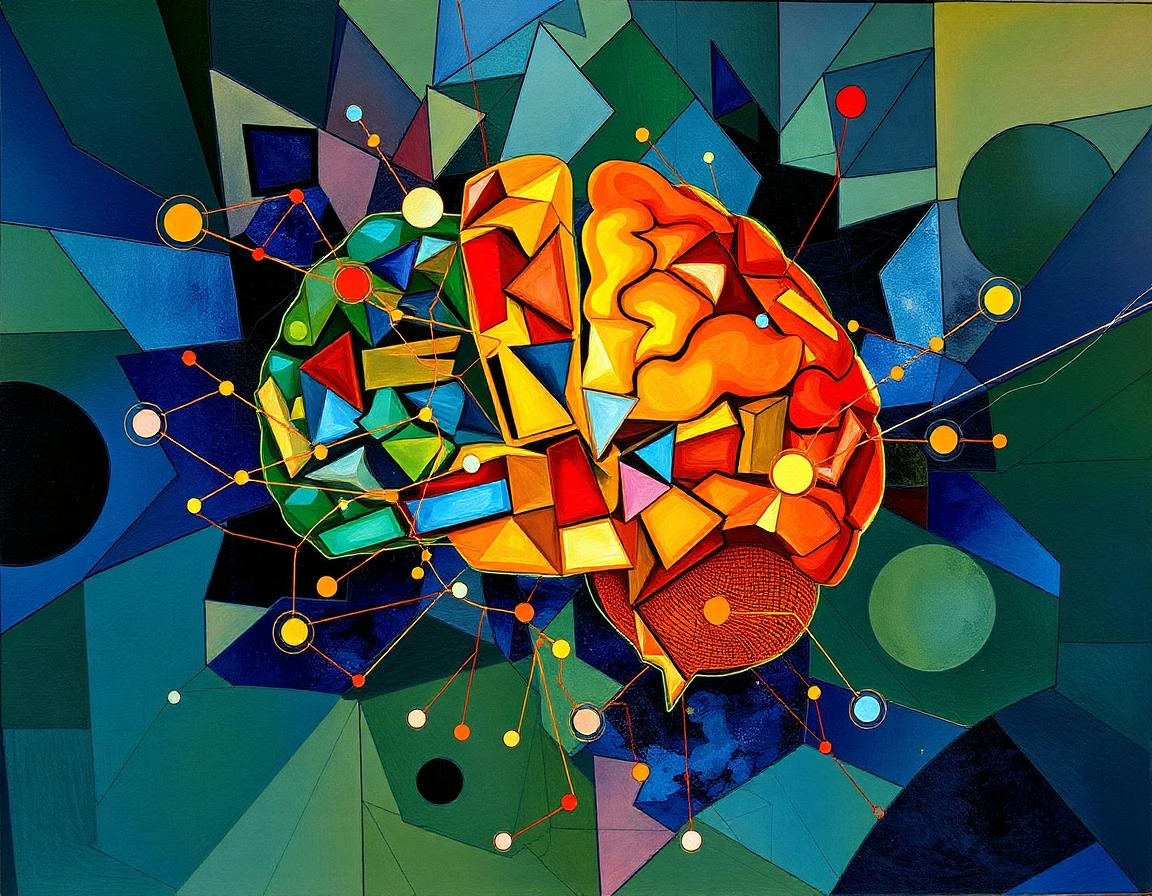
The Essence of Neuroplasticity
Neuroplasticity, the brain’s lifelong ability to reorganize and form new connections, is akin to molding clay. Every interaction and experience leaves an imprint, influencing how we perceive the world and react to it. Christine Grienberger, a prominent neuroscientist at Brandeis University, emphasizes that this plasticity is crucial for learning, enabling us to acquire new skills and adapt to our surroundings.
Despite its well-accepted nature today, the idea that the adult brain is capable of change is relatively recent in the field of neuroscience. For over a century, it was believed that once the brain reached maturity, its structure remained static. Santiago Ramón y Cajal, a key figure in neuroscience, famously posited that the nerve pathways in the adult brain were fixed and immutable. This misconception persisted until the late 20th century when evidence began to emerge that contradicted it.
The Discovery of BTSP
Recent advancements have identified a specific form of neuroplasticity that appears to facilitate learning from single experiences over a brief period. In reviews published in The Journal of Neuroscience and Nature Neuroscience, researchers introduced BTSP, which occurs primarily in the hippocampus—the brain’s memory center. This process involves an electrical change affecting multiple neurons simultaneously, enabling the brain to learn from a single experience.
Daniel Dombeck, a neuroscientist at Northwestern University, asserts that BTSP represents a significant mechanism for immediate memory formation, filling a gap that has long existed in neuroscience. Understanding BTSP not only deepens our knowledge of how the brain adapts but also opens doors to exploring the complexities of learning.
The Role of Dendrites in Learning
At the heart of BTSP are dendrites—protrusions on neurons that receive signals and play a vital role in synaptic plasticity. Recent studies have highlighted the importance of dendritic activity in neuroplasticity, showcasing their capacity to perform complex computations. The dendritic activity can sustain a plateau potential, increasing the likelihood of neuronal firing and contributing to memory formation.
In 2014, Jeffrey Magee and his team began investigating how dendrites behave in living animals. Their research focused on the hippocampus, where they observed that a single burst of activity in a dendrite could trigger a neuron to fire, challenging the long-held belief that multiple stimuli were necessary for learning. This finding was a breakthrough, suggesting that the brain can encode information based on a single, significant event.
The Implications of BTSP for Learning
BTSP has profound implications for understanding how we learn from singular, impactful experiences—such as learning to avoid danger. Magee’s findings suggest that the brain can capture these moments with remarkable efficiency, thus enhancing our ability to remember critical information. This mechanism appears to be particularly relevant for survival, allowing organisms to quickly learn and respond to threats in their environment.
Despite initial skepticism from the scientific community, recent interest in BTSP has surged as researchers explore its potential applications, particularly in artificial intelligence. Attila Losonczy, a scientist investigating BTSP, notes its relevance to single-shot learning, which could help AI systems learn efficiently from minimal data.
Unraveling the Molecular Mechanisms
While BTSP offers an exciting framework for understanding how learning occurs, the exact molecular processes involved remain largely uncharted. Early indications suggest that experiences may leave biochemical traces at synapses, which could enhance synaptic strength during subsequent activity. These eligibility traces might play a crucial role in determining which neural connections are strengthened during learning.
Research is underway to elucidate the mechanisms behind BTSP, with studies indicating that dendritic plateaus could trigger cascades of biochemical signals critical for learning. This process may activate proteins essential for synaptic strength and memory formation, thereby addressing long-standing questions about how the brain assigns significance to particular experiences.
Bridging Old and New Theories
While BTSP challenges traditional notions of Hebbian learning—where connections between neurons strengthen through repeated co-activation—most neuroscientists agree that both mechanisms likely coexist. Hebbian plasticity may be crucial for initial brain development, while BTSP could be more relevant for forming episodic memories in adults. This nuanced understanding underscores the complexity of neuroplasticity and the need for ongoing exploration into the brain’s learning processes.
Conclusion
The discovery of BTSP represents a significant advancement in how we comprehend the brain’s learning capabilities. By revealing that the brain can learn from singular experiences within seconds, this research not only reshapes our understanding of neuroplasticity but also has far-reaching implications for education, artificial intelligence, and therapeutic approaches. As we continue to unravel the mysteries of the brain, we move closer to harnessing its full potential for human development and innovation.
Key Takeaways:
- Neuroplasticity allows the brain to adapt and learn throughout life.
- Behavioral timescale synaptic plasticity (BTSP) enables learning from single experiences.
- Dendrites play a crucial role in facilitating BTSP.
- BTSP may have implications for AI and understanding memory formation.
- The mechanisms behind BTSP remain an active area of research.
Read more → www.quantamagazine.org



