
Raman spectroscopy has emerged as a powerful analytical tool in various fields, driving significant advancements in our understanding of molecular structures and dynamics. The latest research highlights the versatility and potential of this technique, showcasing its application from electrochemical processes to biomedical diagnostics.
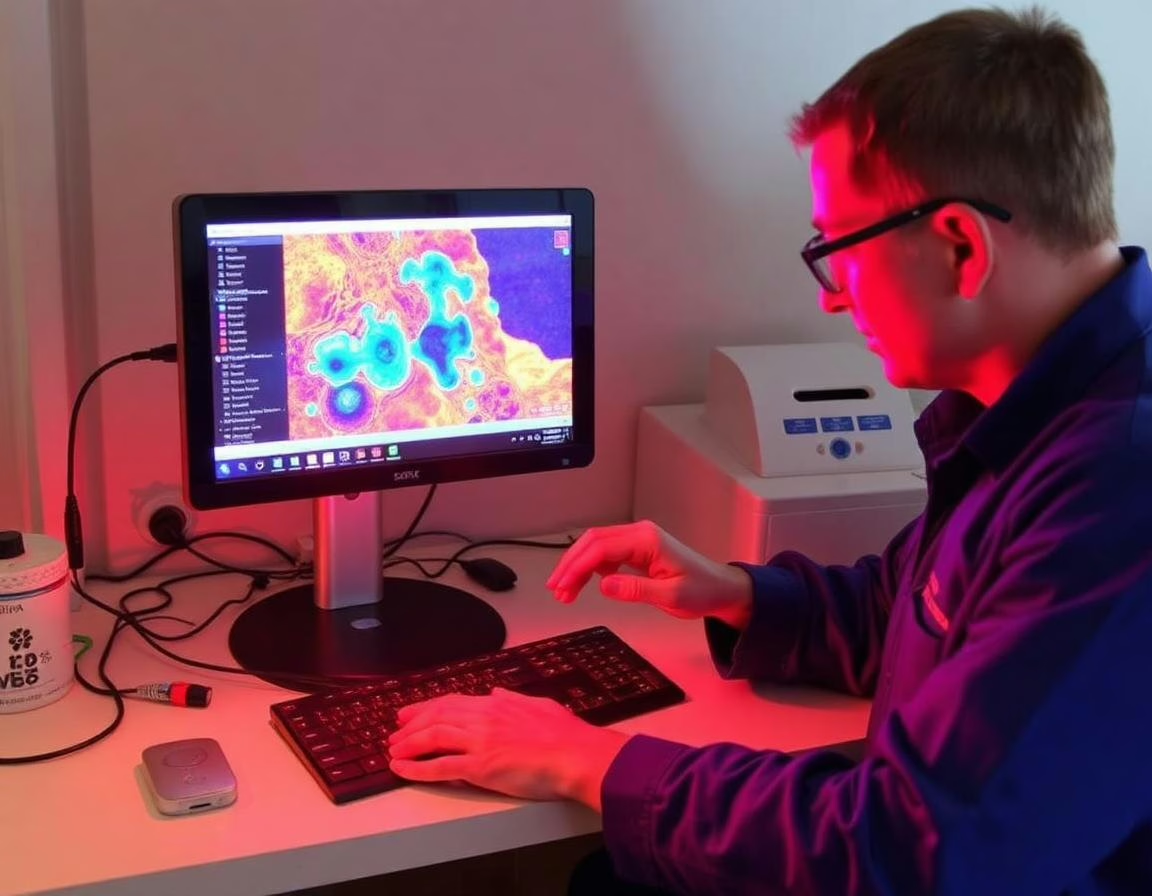
Operando Raman Spectroelectrochemistry
Recent studies have explored the electrochemical conversion of carbon dioxide using molten carbonates. A breakthrough was achieved with operando Raman spectroelectrochemistry, which unveiled the formation of a peroxide intermediate during the reaction. This finding is crucial for optimizing CO2-to-carbon electroreduction processes and understanding the underlying mechanisms.
Enhancements in Surface-Enhanced Raman Scattering
Temperature variations during surface-enhanced Raman scattering (SERS) can complicate analyses. However, a novel approach has shown that heat-assisted hot-hole transfer significantly boosts SERS activity. This mechanism not only enhances the detection capabilities but also opens new avenues for high-temperature applications in materials science and photothermal processes.
Fluorescence-Free Single-Molecule Detection
A significant advancement in single-molecule microscopy has been achieved through the integration of electronically resonant stimulated Raman scattering with non-fluorescent molecular probes. This innovative combination enables far-field detection without the interference of fluorescence, marking a vital step forward in real-time molecular imaging.
Self-Healing Molecular Crystals
The phenomenon of stress-induced symmetry breaking in layered molecular crystals has been harnessed to enable rapid self-healing under ambient conditions. This discovery not only enhances the understanding of material properties but also paves the way for developing resilient materials that can autonomously repair themselves.
Probing Molecular Structures at Interfaces
Understanding the interactions between water and graphite surfaces is essential in various biological and engineering contexts. By correlating three-dimensional atomic force microscopy with surface-enhanced Raman scattering (SHINERS), researchers have identified structural transitions in interfacial water under different electric fields, providing valuable insights into molecular behavior at interfaces.
Advanced Imaging Techniques
The advent of self-referencing ultrafast wide-field pump-probe microscopy has transformed the ability to capture over a million ultrafast traces per second. This technology reveals hidden vibrational modes in two-dimensional materials, facilitating a deeper understanding of their unique properties and interactions.
Real-Time Monitoring of Molecular Structures
Innovative techniques such as computational field-resolved coherent chemical imaging and non-equilibrium anti-Stokes Raman spectroscopy have emerged, enabling the monitoring of vibrational changes and chemical reactions in real time. These methods enhance the capability to investigate complex systems, such as superconductors and biochemical reactions, with unprecedented precision.
Point-of-Care Diagnostics and Drug Classification
The application of SERS in point-of-care diagnostics has gained traction, particularly for assessing drug-induced liver injury through lateral flow immunoassays combined with handheld Raman readers. Additionally, the use of smartphone Raman spectrometers for drug classification showcases the democratization of advanced analytical techniques, making them accessible for broader applications.
Conclusion
The evolving landscape of Raman spectroscopy underscores its significance in scientific research and practical applications. With ongoing advancements in imaging techniques, molecular analysis, and diagnostic methods, this technology continues to unlock new frontiers in understanding materials and biological processes. As researchers push the boundaries, the potential for Raman spectroscopy to revolutionize various domains is immense.
- Key Takeaways:
- Operando Raman spectroscopy reveals critical intermediates in electrochemical reactions.
- Heat-assisted techniques enhance SERS activity for high-temperature applications.
- Innovations in imaging techniques facilitate real-time molecular studies.
- Point-of-care diagnostics and smartphone applications broaden the reach of Raman technology.
- Self-healing materials represent a promising frontier for future research and applications.
Read more → www.nature.com