
Introduction to Edible Insects
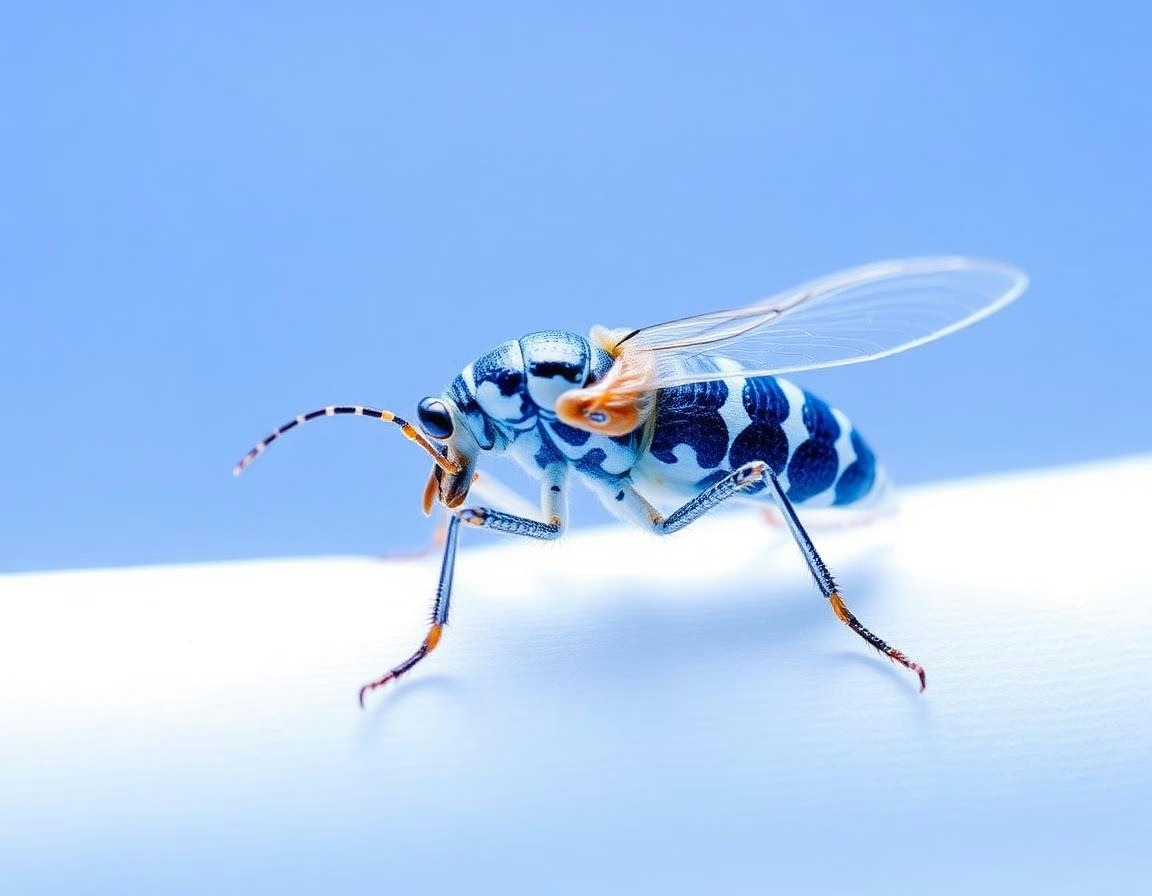
Insect Protein and Fermentation: A Scalable Innovation for Global Food Systems
The integration of insects into human diets represents one of the most promising frontiers in sustainable food innovation and alternative protein development. As global demand for protein accelerates—driven by population growth, urbanization, and rising incomes—traditional livestock systems face increasing pressure due to land use constraints, greenhouse gas emissions, and inefficiencies in feed conversion. In this context, edible insects offer a high-efficiency, low-resource alternative with significant potential for large-scale adoption.
Celeste C. Ibarra-Herrera, a bioengineering professor at Tecnológico de Monterrey, is advancing this field through targeted research in insect-based fermentation and food systems integration. Her work focuses not only on sustainability metrics—such as reduced water usage, lower carbon intensity, and improved feed conversion ratios—but also on the critical challenge of consumer adoption. By combining biochemical engineering with food science, her research aims to transform insects from niche ingredients into standardized, functional components of everyday foods.
Culinary Origins and Cultural Foundations in Puebla
Ibarra-Herrera’s research trajectory is rooted in traditional Mexican gastronomy, specifically in Puebla, where chapulines (grasshoppers) are widely consumed as part of regional cuisine. These insects are incorporated into tacos, quesadillas, and other staple dishes, often seasoned and toasted to enhance flavor and texture.
This cultural baseline is significant from a food systems perspective. Unlike Western markets—where entomophagy faces strong psychological resistance—regions with established culinary traditions provide a natural testing ground for innovation. Exposure to chapulines not only informed Ibarra-Herrera’s research direction but also highlighted a key insight: acceptance of insect-based foods is not purely a technological problem, but a cultural and sensory one.
Her work therefore bridges traditional food practices with modern bioprocessing, positioning insects not as novel commodities but as scalable extensions of existing food systems.
Research Focus: Functional Integration of Insect Proteins into Staple Foods
A central objective of Ibarra-Herrera’s research is the incorporation of insect-derived proteins into globally consumed staple foods, with a particular emphasis on bread. Bread serves as an ideal target matrix due to its ubiquity, standardized processing methods, and compatibility with protein fortification strategies.
From a formulation standpoint, introducing insect flour into wheat-based systems presents both opportunities and constraints. Insect proteins offer high levels of essential amino acids, micronutrients such as iron and zinc, and bioactive compounds. However, they also interact with gluten networks, hydration dynamics, and fermentation kinetics in ways that can disrupt dough rheology and final product quality.
By selecting bread over regionally specific foods such as tortillas, the research strategically targets a globally scalable platform. The goal is to embed insect protein into existing consumption patterns rather than requiring behavioral shifts from consumers.
Nutritional Engineering Through Insect Diet Optimization
A critical and underexplored dimension of insect-based food systems is the ability to manipulate nutritional output through controlled feeding strategies. Ibarra-Herrera’s team investigates how altering the diet of insects—such as incorporating soy sprouts, maize leaves, or other nutrient-rich substrates—affects their biochemical composition.
This approach effectively treats insects as biological converters of feedstock into optimized nutrient profiles. Unlike conventional livestock, insects exhibit rapid growth cycles and high feed conversion efficiency, enabling precise modulation of protein content, lipid composition, and micronutrient density.
The implications are substantial. By engineering the upstream diet of insects, producers can enhance the nutritional value of the final food ingredient before processing even begins. This introduces a level of control analogous to metabolic engineering in microbial systems, positioning insects as programmable nutrient platforms rather than static raw materials.
Technical Challenges in Food Formulation and Sensory Performance
Despite their nutritional advantages, insect-based ingredients introduce significant formulation challenges. The incorporation of grasshopper flour into bread systems alters key sensory and structural attributes, including color, flavor profile, crumb structure, and density.
Insect flours typically exhibit darker pigmentation and distinct flavor compounds, which can lead to consumer rejection if not properly managed. Additionally, their interaction with gluten proteins can weaken dough elasticity, resulting in denser, less aerated bread.
These challenges are not trivial. In food science, sensory acceptance often outweighs nutritional benefit in determining market success. Therefore, overcoming these barriers requires not only ingredient optimization but also process innovation.
Fermentation as a Bioprocessing Solution
To address these constraints, Ibarra-Herrera’s team employs fermentation as a functional modification strategy, specifically utilizing Aspergillus oryzae, a filamentous fungus widely used in traditional Asian fermentations such as miso, soy sauce, and sake.
Fermentation introduces enzymatic activity that can hydrolyze proteins, modify flavor precursors, and alter the physicochemical properties of insect flour. This process reduces off-flavors, improves digestibility, and enhances functional compatibility with wheat-based systems.
Empirical results indicate that fermented insect flour produces bread with improved texture, reduced density, and a more neutral flavor profile compared to non-fermented variants. These improvements are likely driven by proteolytic and amylolytic enzyme activity, which modifies both insect and wheat components during fermentation.
This positions fermentation not merely as a preservation method, but as a critical enabling technology for integrating alternative proteins into conventional food matrices.
Comparative Functional Analysis of Insect Species
The research extends beyond grasshoppers to include other insect species such as Tenebrio molitor (mealworms), which exhibit distinct biochemical and functional characteristics.
Mealworms typically contain higher lipid content and different amino acid distributions compared to grasshoppers, resulting in different interactions during processing. While fermentation improves the nutritional accessibility of both insect types, its effects on texture, flavor, and structural performance vary significantly.
This highlights a key principle in alternative protein development: ingredient selection must be application-specific. Different insect species may be optimized for different product categories, depending on their intrinsic properties and response to processing techniques.
Consumer Acceptance and Food System Integration
Despite clear advantages in sustainability and nutrition, consumer acceptance remains one of the most significant barriers to widespread adoption of insect-based foods. Psychological factors—often referred to as the “yuck factor”—continue to influence purchasing behavior, particularly in Western markets.
Ibarra-Herrera emphasizes that overcoming this barrier requires more than product innovation. It necessitates the development of standardized, food-grade supply chains that ensure safety, consistency, and regulatory compliance. Transparent production processes, quality assurance systems, and branding strategies will be essential in shifting public perception.
Embedding insect protein into familiar food formats—such as bread—also serves as a critical strategy for normalization. By reducing visibility and altering sensory impact, these products can facilitate gradual consumer acceptance.
Industry Adoption and Market Dynamics
Esther Pérez-Carrillo identifies a structural challenge in scaling insect-based food systems: the interdependence between consumer demand and industrial investment.
Food manufacturers are reluctant to invest in insect-based product lines without demonstrated market demand, while consumers lack exposure due to limited product availability. This creates a feedback loop that slows adoption.
Breaking this cycle requires coordinated efforts across research institutions, startups, and established food companies. Pilot programs, co-manufacturing partnerships, and targeted marketing campaigns may play a role in accelerating adoption.
Future Directions: Functional Foods and Bioactive Compounds
Ongoing research by Ibarra-Herrera’s team focuses on further enhancing the protein density and functional properties of insect-enriched foods through advanced fermentation techniques. Particular attention is being given to the generation of bioactive compounds during fermentation, including peptides with potential health benefits.
Additionally, the development of insect-based beverages and alternative food formats is under exploration, expanding the application range beyond baked goods. These innovations align with broader trends in functional foods, where nutritional value is combined with targeted health benefits.
As global food systems face increasing pressure, such approaches represent a convergence of biotechnology, nutrition science, and sustainable production.
Toward Mainstream Adoption of Insect-Based Foods
The normalization of insect consumption is unlikely to occur through radical shifts in behavior, but rather through gradual integration into existing dietary patterns. By embedding insect-derived ingredients into familiar food systems, researchers and industry stakeholders can reduce barriers to acceptance while leveraging their nutritional and environmental advantages.
Ibarra-Herrera’s work demonstrates that the future of food may not depend solely on novel ingredients, but on the ability to transform those ingredients into forms that align with established habits, expectations, and sensory preferences.
As technological innovation converges with cultural adaptation, insects may transition from peripheral food sources to core components of global nutrition systems.
Takeaways
- Ibarra-Herrera’s research focuses on incorporating insects into staple foods like bread.
- Fermentation can improve the flavor and texture of insect-based ingredients.
- Consumer acceptance is crucial for the successful integration of insects into diets.
- A robust supply chain is necessary to ensure quality and safety of insect products.
- The research aims to address ongoing global food security challenges through innovative solutions.
Read more → www.ift.org



