
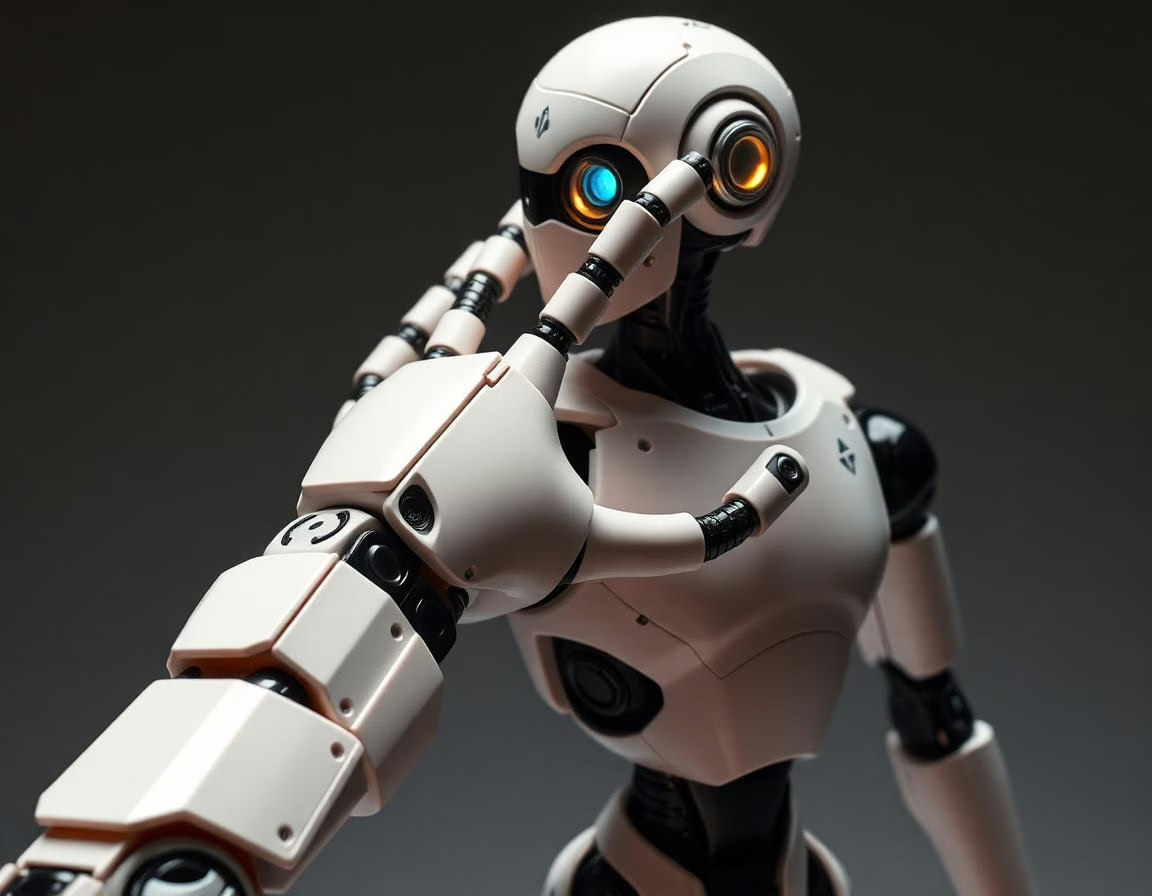
The quest for advanced robotics has led researchers to tackle one of the most intricate challenges: enabling robots to perform delicate tasks with the finesse of a human hand. Traditional robotic hands excel in gripping but struggle with nuanced motions such as using scissors or playing a musical instrument. A breakthrough in sensor technology promises to bridge this gap, allowing humanoid robots to achieve remarkable precision in their movements.
The Challenge of Proprioception
At the heart of this challenge lies the concept of proprioception, the body’s ability to sense its position and movement in space. While human fingers possess this innate ability, robotic systems have historically fallen short. The inability to accurately perceive finger posture across multiple degrees of freedom limits their effectiveness in performing tasks that require fine motor skills.
Existing soft sensors often face limitations, tracking only one bending mode or experiencing interference when fingers flex and move sideways. This inconsistency hampers the transition from basic grasping to true dexterous manipulation. Addressing these issues has become imperative for advancing robotic capabilities.
A Hybrid Solution
Researchers from several institutions have collaborated to develop a revolutionary “rigid-soft” hybrid hand that integrates omnidirectional bending sensors, enabling real-time tracking of finger movements. This innovative design allows the robotic hand to perceive both pitch and yaw at the finger joints, improving its ability to replicate human-like dexterity.
The new system features 18 active degrees of freedom and five flexible fingers, each equipped with an advanced soft optical sensor. By utilizing a combination of segmented PMMA fibers, a trichromatic LED, and a chromatic detector, the hand can accurately measure how light is affected as the sensor bends. This optical approach allows for the decoupling of the two movements, providing precise feedback for complex tasks.
Performance and Accuracy
The performance of this cutting-edge hand has been rigorously tested, revealing impressive repeatability and accuracy. In trials, the sensors demonstrated minimal measurement errors, achieving only ±2.13° for pitch and ±2.34° for yaw. The low levels of crosstalk between the two movements further enhance the reliability of the system. The ability to maintain accurate sensing while executing complex hand movements represents a significant advancement in robotic technology.
Implications for Human-Robot Interaction
The implications of this research extend beyond technical achievements. Enhanced hand dexterity opens doors to safer and more effective human-robot interactions, where robots can assist in various delicate tasks. For instance, the ability to use scissors or operate a computer mouse with human-like precision can greatly improve the utility of robots in everyday settings.
Additionally, the soft sensors’ durability and adaptability suggest potential applications in prosthetics, enabling users to perform intricate tasks like typing or playing an instrument with higher accuracy. This could revolutionize the quality of life for individuals reliant on such devices.
Future Directions
As researchers delve deeper into the capabilities of soft sensors, the future of humanoid robotics looks promising. The integration of advanced sensing technologies with flexible designs paves the way for further innovations that could redefine robotic dexterity. Ongoing studies will likely explore additional applications across various fields, including healthcare, manufacturing, and entertainment.
The development of this omnidirectional soft bending sensor marks a significant milestone in the journey towards creating robots that can mimic human dexterity. By enhancing robots’ ability to perceive their own movements and adjust accordingly, researchers are not only improving robotic functionality but also bringing us closer to a future where robots seamlessly integrate into human environments.
Key Takeaways
- Proprioception Limitation: Traditional robotic hands struggle with fine motor skills due to a lack of proprioception.
- Hybrid Design: The new “rigid-soft” hybrid hand features omnidirectional bending sensors for improved movement perception.
-
Enhanced Performance: The system shows low measurement errors and minimal crosstalk, enhancing reliability in complex tasks.
-
Broader Applications: Implications extend to prosthetics, improving the quality of life for users.
-
Future Innovations: Ongoing research may lead to further advancements in humanoid robotics and their applications.
In conclusion, the advancements in soft sensing technology herald a new era for humanoid robots, enhancing their ability to perform intricate tasks with improved precision. As these innovations continue to evolve, the line between human and robotic dexterity blurs, opening up exciting possibilities for the future.
Read more → neurosciencenews.com