
The quest to replicate the intricate movements of the human hand has long captivated engineers and researchers in robotics and virtual reality. With 34 muscles and 22 degrees of freedom, the human hand exemplifies remarkable dexterity. Recent advancements, however, have led to the development of an innovative wearable ultrasound wristband that tracks these complex movements in real time with exceptional accuracy.
How It Works
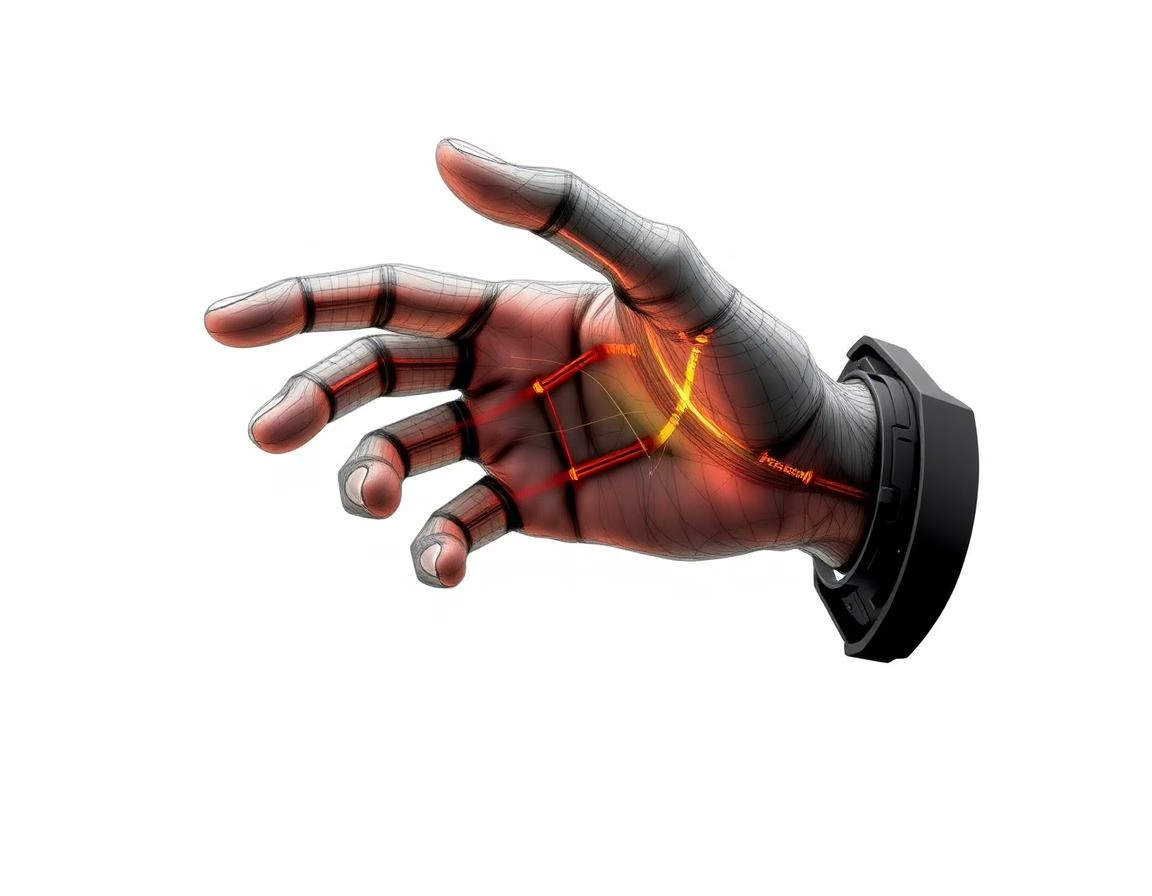
This cutting-edge wristband employs ultrasound technology to capture images of the wrist’s muscles and tendons as they shift during hand movements. By harnessing a sophisticated AI algorithm, the device decodes these images and translates the user’s gestures into corresponding motions of a robotic hand or a virtual avatar. Demonstrations have shown the wristband enabling users to play the piano through a robotic interface and manipulate virtual objects effortlessly.
The Challenge of Hand Movements
The human hand’s dexterity is nothing short of astonishing. Everyday actions, such as scrolling on a smartphone, rely on a complex interplay of muscles, joints, and tendons. Engineers have grappled with the challenge of mimicking these nuanced gestures in robotics and virtual environments, often falling short of achieving the necessary precision.
A Leap Forward in Technology
MIT engineers have successfully designed a wristband that continuously monitors hand movements. This device generates real-time ultrasound images of the wrist’s anatomy and employs an AI algorithm to correlate these images with the precise positions of the fingers and palm. This breakthrough allows the wristband to learn a wearer’s unique hand motions and communicate them instantaneously to a robot or virtual environment.
Real-World Applications
In practical demonstrations, users wearing the wristband have been able to wirelessly control a robotic hand, allowing it to mimic gestures such as pointing or playing music. The wristband’s capabilities extend beyond robotics; it can also manipulate digital objects on a screen, allowing users to easily zoom in and out or interact with virtual tools through intuitive gestures.
The research team is expanding their dataset by gathering hand motion data from a diverse range of users. This initiative aims to create a comprehensive database of hand gestures that can enhance the dexterity of humanoid robots and improve interactions in various applications, including video games and design software.
Advantages Over Existing Technologies
Current methods for capturing hand movements often involve cameras, sensor-laden gloves, or electrical signals from muscles. Each of these techniques has limitations—cameras require a clear line of sight and can be obstructed, gloves can hinder natural movement, and electrical signals are susceptible to environmental noise. In contrast, the ultrasound wristband offers a non-invasive solution that captures the full range of motion without these drawbacks.
Innovative Ultrasound Imaging
The ultrasound wristband utilizes miniaturized transducers paired with hydrogel materials to adhere safely to the skin. This design allows for continuous imaging of the wrist’s internal structures, capturing the delicate movements of muscles and tendons. The researchers liken the tendons and muscles to strings controlling puppets: as the hand moves, the wristband captures the state of these “strings” to determine the corresponding hand position.
Training the AI Algorithm
The challenge of interpreting ultrasound images in real time required the integration of artificial intelligence. By leveraging a dataset of labeled ultrasound images, the AI learns to recognize patterns and correlate them with specific movements of the fingers and thumb. This training process involved capturing hand motions with both the wristband and multiple cameras, allowing the AI to establish accurate connections between the internal images and external hand positions.
Testing and Future Developments
The wristband has undergone extensive testing with a diverse group of volunteers, successfully tracking various hand gestures, including American Sign Language signs and the manipulation of everyday objects. To showcase its potential, the research team developed a simple computer program that wirelessly connects to the wristband, enabling users to interact with virtual objects seamlessly.
Looking ahead, researchers plan to refine the wristband’s design and expand its capabilities by training the AI on an even broader range of gestures. The ultimate goal is to create a universal hand tracker that can be worn by anyone, facilitating high-dexterity interactions with humanoid robots or digital environments.
Conclusion
The ultrasound wristband represents a monumental step forward in the quest to understand and replicate the dexterity of the human hand. By combining innovative ultrasound imaging with sophisticated AI, this technology promises to redefine interactions in robotics and virtual reality. As we continue to explore its applications, the potential for intuitive and versatile control of digital and robotic entities seems boundless.
- Key Takeaways:
- The wristband captures hand movements with precision using ultrasound technology.
- It enables real-time translation of gestures into robotic or virtual actions.
- The integration of AI enhances the wristband’s ability to learn and predict hand positions.
- Future developments aim to expand its applications in diverse fields, including gaming and robotics.
- This technology could replace traditional hand tracking methods, offering a more natural interaction experience.
Read more → neurosciencenews.com