
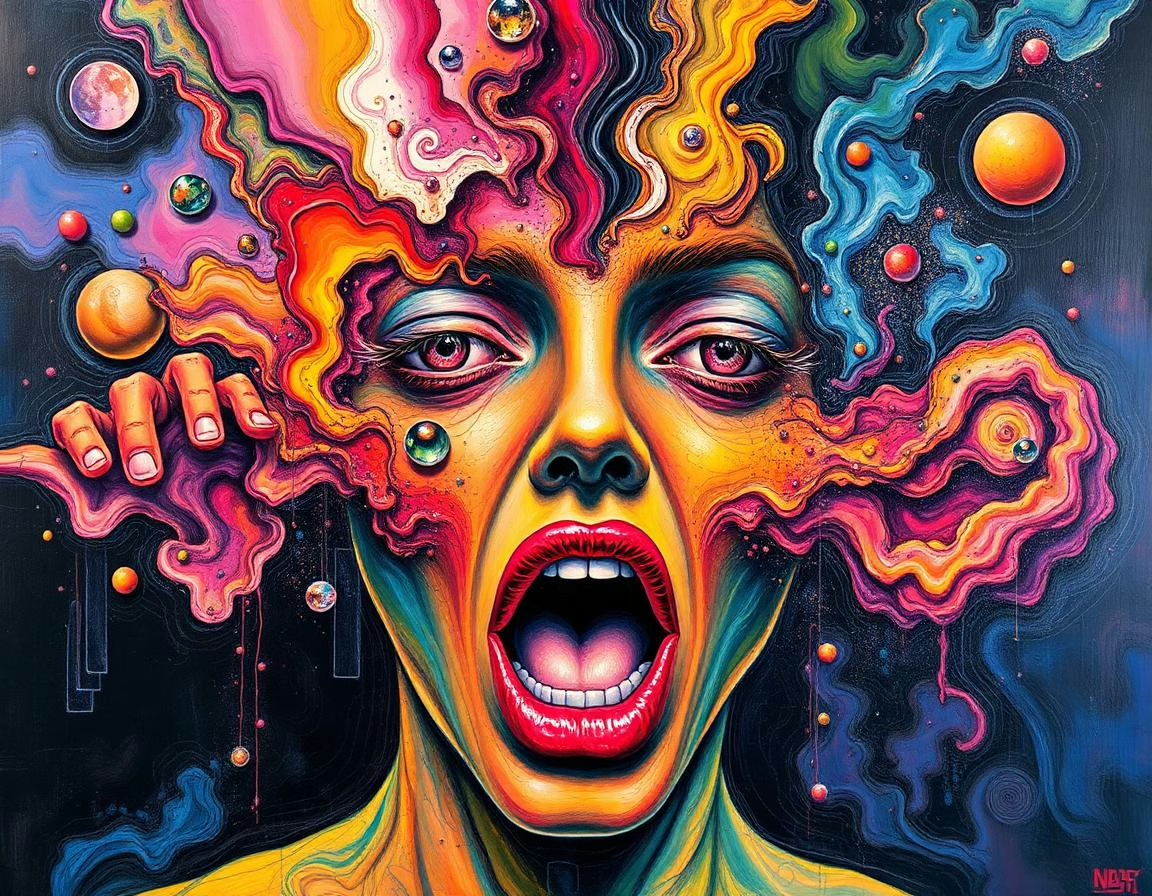
Human facial expressions serve as a universal language, conveying emotions such as happiness, anger, or surprise. However, when it comes to the intense pleasure of sexual climax, this language seems to falter, revealing a perplexing phenomenon where joy and agony share similar facial cues. Recent research has begun to unravel the complexities of this “orgasm face,” shedding light on its evolutionary roots and cultural influences.
The Fascinating Paradox
During moments of sexual ecstasy, individuals often display facial expressions that closely resemble those of pain. This surprising similarity has intrigued scientists across disciplines, including psychology and evolutionary biology. By examining videos, computer simulations, and the behaviors of other primates, researchers are constructing a clearer understanding of the facial expressions associated with orgasm.
To capture genuine expressions, scientists faced the challenge of privacy and ethical concerns. A pioneering study analyzed videos voluntarily shared online, featuring individuals recording their faces during sexual excitement and climax. Using a systematic coding framework, researchers tracked muscle movements to identify which expressions are common during different stages of sexual arousal.
The Facial Indicators of Climax
Findings from this research indicated that during climax, participants often exhibited closed eyes, lowered brows, and a dropped jaw—facial cues that are strikingly similar to those of pain. The core movements typically associated with agony, such as tightening the muscles around the eyes and raising the upper lip, frequently appeared during moments of sexual release.
This raises an intriguing question: how do we discern between pleasure and pain when the facial expressions are so alike? A related study proposed the “peak emotion paradox,” suggesting that during heightened emotional episodes, we rely on contextual cues from the body to interpret feelings accurately.
Context is Key
In this study, photographs of individuals responding to winning tennis points, undergoing painful piercings, and experiencing orgasm were shown to participants. When isolated, faces from both positive and negative experiences were often indistinguishable, with positive faces sometimes rated as slightly negative. It became evident that the overwhelming intensity of an emotional experience can obfuscate facial signals.
To further investigate, researchers manipulated images, pairing faces of sexual pleasure with bodies experiencing pain. Participants’ interpretations shifted dramatically based on the body’s context, indicating that our understanding of emotions is heavily influenced by the overall physical presentation.
Distinct Mental Models
While our facial expressions may blur the lines between pleasure and pain, our cognitive processing delineates these states distinctly. In a study exploring mental representations of orgasm, researchers generated random facial animations for participants from different cultural backgrounds to categorize as either pain, orgasm, or neutral.
The results revealed a stark contrast in mental models: pain expressions involved inward movements, while orgasm represented outward expansion. Cultural differences emerged as well, with Western participants linking climax to wide eyes and open mouths, whereas East Asian participants favored closed mouth smiles. These findings highlight how cultural values shape our expectations and interpretations of sexual pleasure.
Gender Differences in Perception
The role of sexual expressions in human relationships leads to intriguing gender disparities in perception. A study examined whether men and women could accurately recognize intense emotions, presenting them with photographs of men and women in states of extreme pain or sexual pleasure.
Participants demonstrated a higher accuracy in identifying pain compared to pleasure, likely due to the attention-grabbing nature of negative emotions, a survival mechanism rooted in our evolutionary history. Interestingly, women excelled at recognizing pain in other women, while men were better at identifying female sexual pleasure, possibly reflecting an evolutionary adaptation aimed at reproductive success.
Evolutionary Insights from Primate Behavior
To delve deeper into the origins of our sexual expressions, scientists often turn to our closest evolutionary relatives. Bonobos, known for employing sexual behavior to alleviate tension and foster social bonds, provide valuable insights. Observations of their “silent bared teeth display” during sexual interactions reveal a phenomenon called rapid facial mimicry, where partners unconsciously imitate each other’s expressions.
This mirroring behavior not only enhances emotional connectivity but also prolongs sexual engagement, suggesting that sexual facial expressions evolved as a communicative tool essential for social bonding.
The Role of Climax in Reproductive Strategy
The female orgasm also serves critical reproductive functions, challenging early theories that deemed it a mere biological accident. Current research posits that the female climax is an evolutionary adaptation influencing mate selection. Women are more likely to reach climax with partners displaying desirable traits, such as physical attractiveness and genetic fitness.
Physiologically, the contractions associated with climax facilitate sperm transport, occurring more frequently during the fertile window of the menstrual cycle. This aligns with the hypothesis that the female orgasm aids in selectively retaining high-quality sperm, thereby enhancing reproductive success.
The Cultural Impact on Sexual Expression
The portrayal of sexual climax in modern media further complicates our understanding of these expressions. An analysis of popular adult entertainment revealed significant discrepancies in how male and female orgasms are depicted. Women’s climaxes are often exaggerated and prominently featured, while men’s pleasure is frequently obscured, primarily indicated by physical fluids.
This representation reinforces cultural narratives that pressure individuals to perform specific expressions during sexual encounters, leading to anxiety and, in some cases, the faking of orgasms. The disconnect between biological realities and cultural expectations can create unnecessary stress around sexual satisfaction.
Conclusion
The interplay between biology, evolution, and cultural conditioning shapes the expressions we display during sexual climax. While our faces may convey a confusing blend of pleasure and pain, our understanding of these moments is more nuanced than it appears. By exploring the science behind the orgasm face, we gain insight into human behavior, revealing the intricate layers of our most intimate experiences and the evolutionary forces that continue to influence them.
- Facial expressions during climax often resemble those of pain.
- Cultural background affects how sexual pleasure is visualized.
- Gender differences exist in recognizing expressions of pain and pleasure.
- Primate behavior provides insights into the evolutionary purpose of sexual expressions.
- Modern media representations can distort perceptions of sexual climax.
Read more → www.psypost.org