
The intricate web of the brain’s microvasculature plays a crucial role in delivering essential oxygen and nutrients to neurons. Traditional imaging methods have allowed scientists to observe neuronal activity, but they have fallen short in capturing the nuanced workings of microvascular systems in real-time. This limitation has impeded research into conditions like cerebral small vessel disease, which significantly impacts cognitive function and is a contributor to dementia.
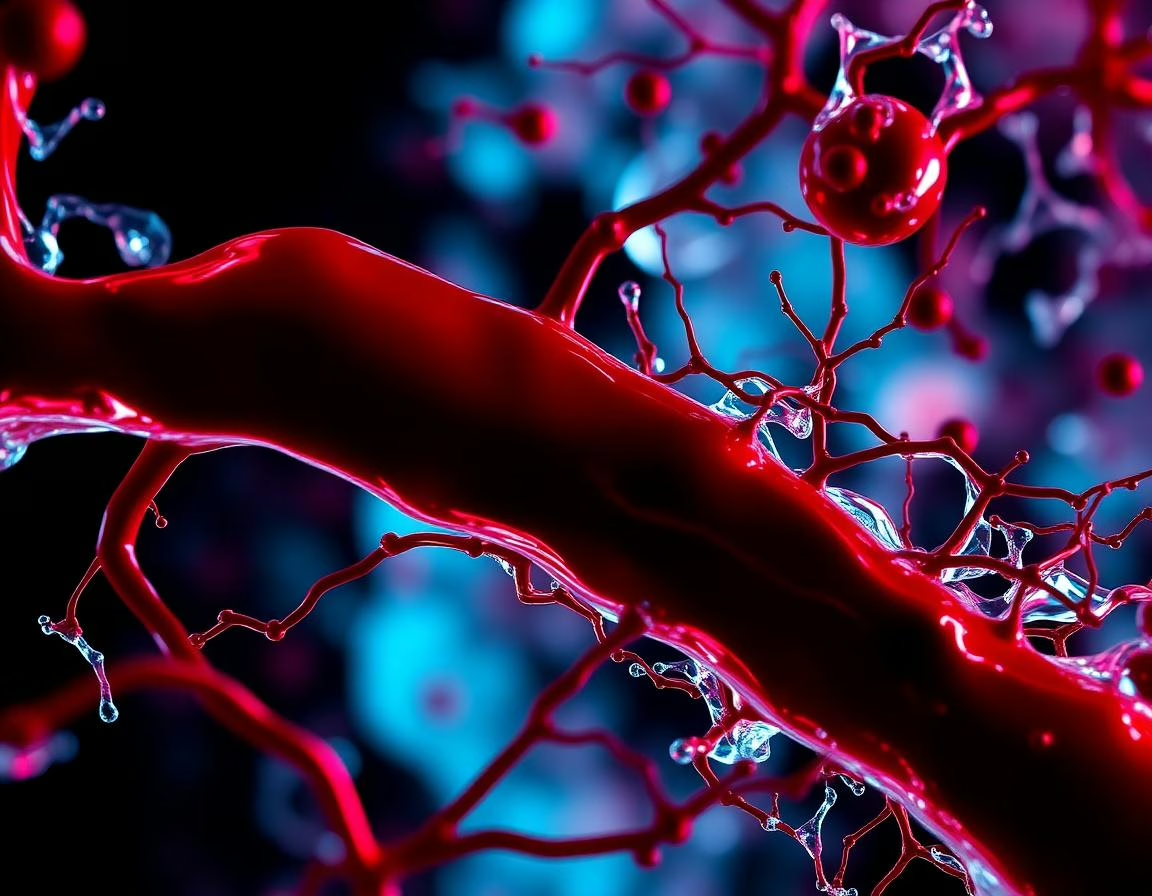
To bridge this gap, a research team from Washington University in St. Louis and Northwestern University, led by Song Hu, has created a groundbreaking technology known as super-resolution functional photoacoustic microscopy (SR-fPAM). This innovative method enables the visualization of blood flow and oxygenation at an unprecedented single-cell resolution within the mouse brain. By allowing researchers to observe the dynamics of red blood cells, SR-fPAM opens new pathways for understanding microvascular health and diseases like stroke and Alzheimer’s.
Unveiling Red Blood Cell Dynamics
Red blood cells (RBCs) are abundant in the bloodstream and are characterized by their ability to absorb light due to hemoglobin. This protein, vital for oxygen transport, plays a key role in the photoacoustic effect, where short laser pulses trigger ultrasound waves. Conventional photoacoustic microscopy has been limited in its capacity to achieve 3D imaging at the resolution of individual cells, until now.
Hu’s team has overcome this hurdle by engineering a high-speed photoacoustic microscope capable of capturing rapid sequences of images. This technology allows for the tracing of red blood cells as they navigate through capillaries and larger vessels, providing invaluable data on their movement and interactions.
Imaging Advanced Microvascular Structures
The SR-fPAM technology’s ability to capture the movement of red blood cells across time provides a more comprehensive view of the microvascular landscape. By accumulating trajectories from sequential imaging frames, researchers can reconstruct detailed 3D representations of microvascular structures at single-cell resolution. This capability significantly enhances our understanding of blood flow dynamics within the brain.
In experimental trials, SR-fPAM has revealed crucial information about how blood flow and oxygenation shift across microvascular networks during pathological events, such as strokes. Observations showed that when a microvessel becomes obstructed, surrounding vessels quickly adapt their flow patterns to ensure continued oxygen delivery to the affected area.
Real-Time Observations of Vascular Response
The implications of SR-fPAM are profound. Hu noted that red blood cells exhibit remarkable adaptability when a vessel is compromised. They reroute through alternative paths to maintain the necessary flow and oxygen supply. By utilizing SR-fPAM, researchers can not only visualize these structural changes but also monitor how quickly red blood cells respond to disruptions and how they deliver oxygen to neighboring tissues.
This real-time imaging capability allows for a deeper understanding of the brain’s vascular response to ischemia, which is critical for developing interventions aimed at mitigating damage during stroke events.
Future Directions: Combining Technologies for Enhanced Insights
Looking ahead, Hu and his team aspire to integrate SR-fPAM with two-photon microscopy. This combination will enable simultaneous imaging of red blood cells and neurons, providing a holistic view of how these two systems interact. Such advancements could yield insights into the spatiotemporal coordination between neuronal activity and microvascular dynamics, especially in the context of disease.
This integrated approach may also enhance the interpretation of existing clinical neuroimaging techniques, such as functional MRI, which relies on vascular signals to infer brain activity.
Translational Impact on Cognitive Health
The potential impact of this research extends beyond basic science. Cerebral small vessel disease is increasingly being recognized as a leading contributor to cognitive decline and dementia. By enhancing our understanding of microvascular changes during early stages of disease, this research could inform the development of early detection strategies and therapeutic interventions.
Hu emphasizes the importance of this work, stating that it places Washington University at the forefront of research into microvascular health, both in fundamental studies and clinical applications.
Key Takeaways
- Innovative Technology: SR-fPAM enables real-time imaging of blood flow and oxygenation at single-cell resolution in the brain.
- Dynamic Observations: The technology reveals how red blood cells adapt their flow patterns in response to blockages, crucial for sustaining oxygen delivery.
-
Future Integration: Plans to combine SR-fPAM with two-photon microscopy could revolutionize understanding of neuron-microvessel interactions.
-
Clinical Relevance: Findings could guide strategies for early detection and treatment of conditions like dementia and stroke.
In conclusion, the development of super-resolution functional photoacoustic microscopy marks a significant leap forward in our ability to visualize and understand the brain’s microvascular systems. As researchers continue to refine this technology and explore its applications, the potential for breakthroughs in cognitive health and disease management becomes increasingly promising.
Read more → www.news-medical.net



