
Revolutionizing surgical education, St Mark’s National Bowel Hospital has collaborated with Cambridge’s Revolve Labs to create groundbreaking virtual reality (VR) training modules. This initiative marks the beginning of an innovative series aimed at reshaping how surgical procedures are taught, enhancing both the learning experience for trainees and the quality of patient care.
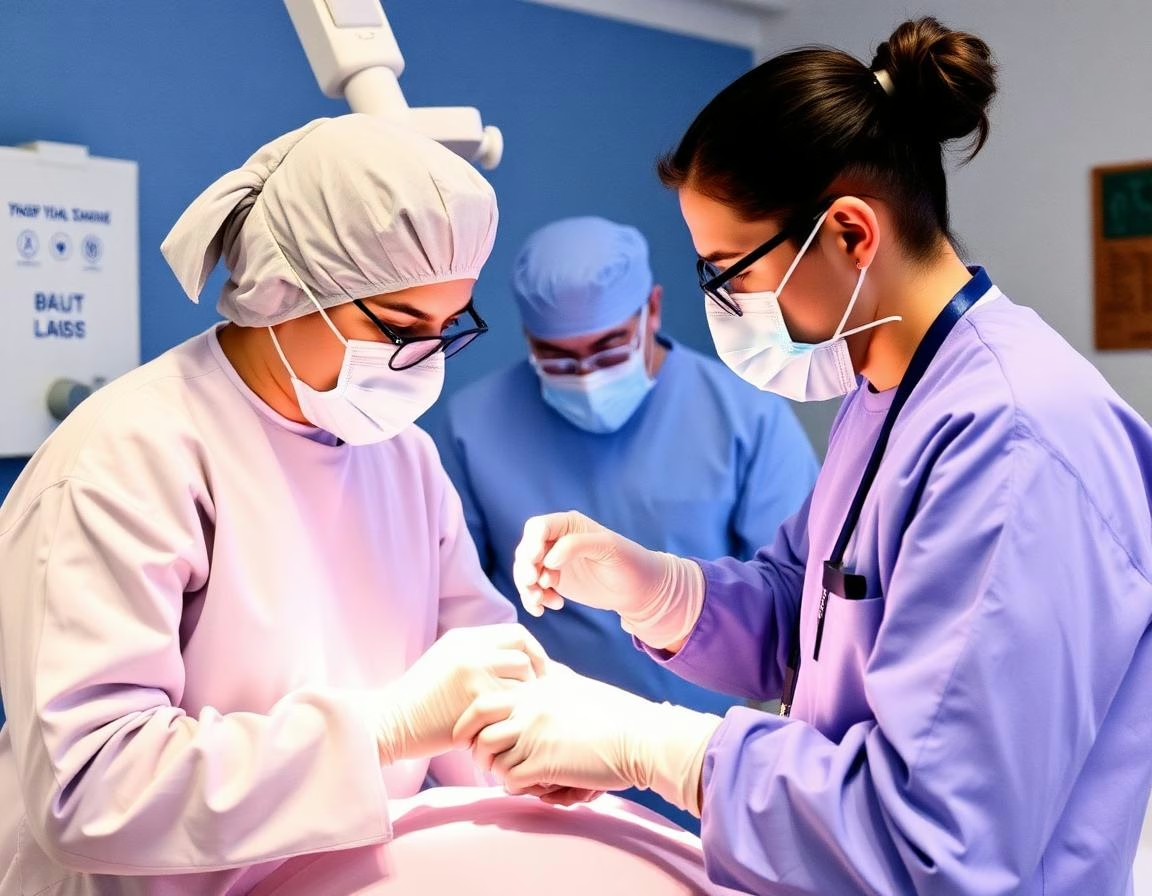
The Power of Virtual Reality
Virtual reality technology offers a unique opportunity for novice surgeons to engage with complex procedures in a simulated environment, free from the pressures of the operating room. By immersing trainees in a realistic setting, they can learn at their own pace, reinforcing their understanding of intricate surgical techniques.
Karl Gaffney, a professor of rheumatology and director at Rheumatology Events, emphasizes the significance of this partnership. He notes that Revolve Labs brings a valuable blend of educational expertise and technological advancement, making them a reliable collaborator in developing high-quality VR learning experiences tailored for medical professionals.
Capturing a Complex Procedure
As part of this initiative, consultant colorectal surgeon Kapil Sahnan invited Revolve Labs to document a robotic pan-proctocolectomy—a complex procedure that requires removing the entire colon, rectum, and anus, followed by rerouting the small intestine. This five-and-a-half-hour operation poses significant challenges, but the technology employed by Revolve Labs allows for a detailed and immersive instructional experience.
The team utilized an array of 360-degree cameras, GoPros mounted on the surgeons’ heads, and stereoscopic outputs from the renowned Da Vinci surgical robot. This comprehensive approach resulted in over 16 hours of footage, capturing both broad perspectives of the surgical theatre and the intricate 3D views experienced by the surgeon at the console.
Immersive Learning Experience
The culmination of this extensive recording effort is a VR training module that vividly recreates the pan-proctocolectomy procedure. Trainees can don VR headsets to switch between various viewpoints, gaining access to additional information, and revisit specific stages of the operation. This capability enhances their learning experience, allowing them to absorb and review key surgical techniques repetitively.
Gita Lingam, a surgical trainee at St Mark’s, expresses enthusiasm for the potential impact of this technology. She highlights that the ability to watch 3D surgical footage independently of the operating theatre is revolutionary. This tool will facilitate repeated observation of critical steps, thereby improving the overall training process.
Enhancing Surgical Skills
The introduction of these VR simulation modules is expected to significantly bolster the training of future surgeons. By providing a platform for extensive observation of surgical procedures, these modules aim to enhance both the skill level of trainees and the overall outcomes for patients.
Hamish Mackenzie, the CEO of Revolve Labs, shares insights into the technical challenges faced during the project. Access to the theatre was granted only the evening before the operation, necessitating a meticulous setup, including a direct feed from the surgical robot. Capturing clear depth and detail within the body was a complex task, but the software developed by Revolve Labs, in conjunction with standard VR headsets, renders a true 3D vision. This enhanced clarity allows trainees to comprehend anatomical planes and procedural steps more effectively than traditional video formats.
A New Era in Medical Training
The collaborative effort between Revolve Labs and St Mark’s Hospital is a testament to the evolving landscape of medical education. By integrating advanced technology into surgical training, healthcare professionals can expect to see a new era of learning that prioritizes immersion and interactivity.
The real-world application of this technology in clinical settings not only showcases its potential but also sets a precedent for future innovations in medical training. As Mackenzie notes, the challenge of capturing a live surgical procedure is daunting; however, the results have proven the effectiveness of VR in enhancing surgical education.
Future Perspectives
As this partnership progresses, the hope is that these VR modules will become a cornerstone of surgical training programs worldwide. With the ability to simulate complex procedures in stunning detail, future surgeons will be better prepared for the real-life challenges they will face in the operating room.
In conclusion, the collaboration between Revolve Labs and St Mark’s National Bowel Hospital exemplifies the transformative power of technology in medical education. By leveraging VR to enhance training, the potential for improved surgical proficiency and patient outcomes is substantial.
- Immersive Learning: Trainee surgeons can learn complex procedures in a simulated environment.
- Real-Time Observation: Access to multiple viewpoints enhances understanding of surgical techniques.
- Enhanced Clarity: True 3D vision improves comprehension of anatomical details and procedural steps.
- Future Innovations: This initiative sets a precedent for the integration of technology in medical training.
- Patient Outcomes: Improved training methods could lead to better surgical results and patient care.
Read more → www.cambridgeindependent.co.uk



