
Understanding the intricate structure of plant cells can lead to revolutionary advancements in both medicine and agriculture. Researchers at the University of California, Davis, have made significant strides in mapping the augmin protein complex, a crucial element in cell structure that connects plant biology to human health, particularly in the context of cancer therapies.
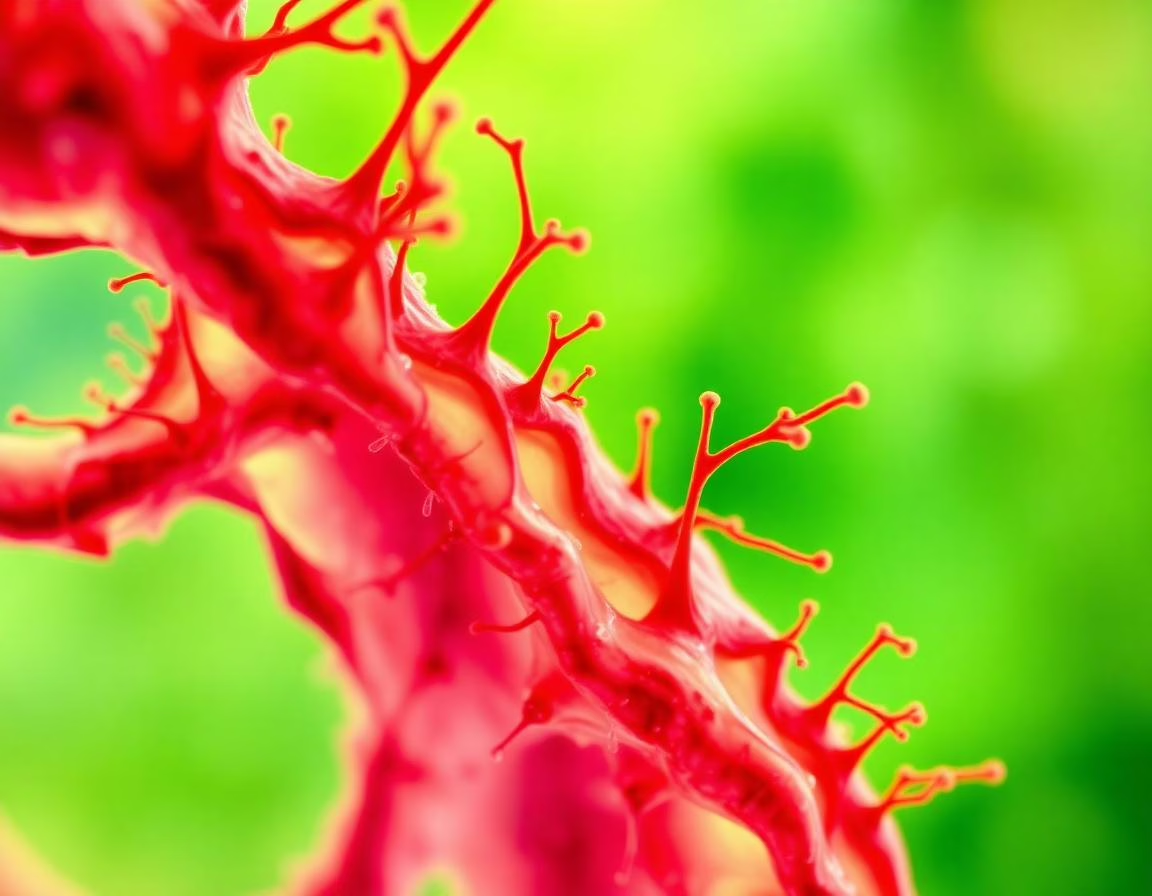
The Role of Augmin in Cell Structure
Augmin is a protein complex that plays a vital role in the assembly and regulation of microtubules, which serve as the internal skeleton of cells. These microtubules are essential during cell division, as they form a structure known as the spindle, which ensures the proper distribution of chromosomes to daughter cells.
Defects in augmin can lead to infertility in humans and are associated with certain types of cancers. The relationship between augmin’s function in plants and its implications for human health is a focal point of the research being conducted at UC Davis.
The Morphing Skeleton of Cells
Every plant and animal cell possesses a dynamic skeleton that shapes its structure. This skeletal system allows for cell expansion, bending, and stretching, which is crucial for the growth and development of various organisms.
During cell division, microtubules extend and grasp chromosomes, pulling them apart to ensure accurate genetic replication. The assembly of these microtubules occurs from protein blocks known as tubulin. This intricate process is vital for maintaining cellular integrity and function.
Discovery of Plant Augmin
Initially, the role of augmin was thought to be specific to animal cells. However, in 2011, researchers discovered a set of eight augmin genes in Arabidopsis thaliana, a model organism in plant research. This finding revealed that plant augmin shares a structural similarity with its animal counterpart and plays a crucial role in both cell division and the regulation of cell shapes.
Impact on Crop Development
The influence of augmin extends beyond basic cellular functions; it significantly affects the traits of crop plants. For instance, the dramatic ballooning of orange juice cells is driven by a microtubule scaffold that augments cell size, while the elongated shape of long-grained rice is also a result of microtubule activity.
In cotton, augmin helps fiber cells extend from their original size to thousands of times larger, allowing for the development of commercially valuable fibers. The understanding of augmin’s role in these processes could lead to innovative breeding strategies for improved crop varieties.
Investigating the Structure of Augmin
Despite the knowledge gained about augmin, the detailed physical structure of the protein complex remained elusive. To address this, researchers collaborated to utilize advanced imaging techniques, specifically Cryo-electron microscopy (CryoEM). By cooling the augmin proteins to extremely low temperatures and capturing thousands of images, they were able to construct a comprehensive structural model.
This process was akin to assembling a puzzle without having the complete picture. The effort culminated in identifying the unique features of the augmin complex, likened to a pitchfork in its appearance.
Implications for Cancer Research
The findings related to plant augmin have broader implications for understanding human health. Abnormal levels of augmin protein are linked to poor outcomes in various cancers, including those affecting the liver and brain. By elucidating the mechanisms of augmin, researchers hope to uncover new therapeutic targets and strategies for treating these malignancies.
Additionally, insights gained from plant augmin may also help identify potential causes of infertility in humans, leading to new avenues for research and treatment development.
A Collaborative Endeavor
The extensive research on augmin is a testament to the power of collaboration in science. Researchers from different disciplines came together, pooling their expertise to uncover the complexities of this protein complex. This project not only enhances our understanding of cell biology but also has the potential to translate into real-world applications in medicine and agriculture.
In conclusion, the exploration of plant cell structure, particularly the augmin protein complex, holds promise for significant advancements in cancer treatment and crop improvement. The interconnectedness of plant and animal biology underscores the potential for cross-disciplinary research to address some of the most pressing challenges in health and food security.
- Key Takeaways:
- Augmin is vital for microtubule assembly in both plants and animals.
- The structure of augmin can inform cancer treatment strategies.
- Understanding augmin can lead to improved crop varieties.
- Collaborative research enhances scientific discovery.
- The dynamic nature of cellular structures is crucial for growth and development.
Read more → www.ucdavis.edu



