
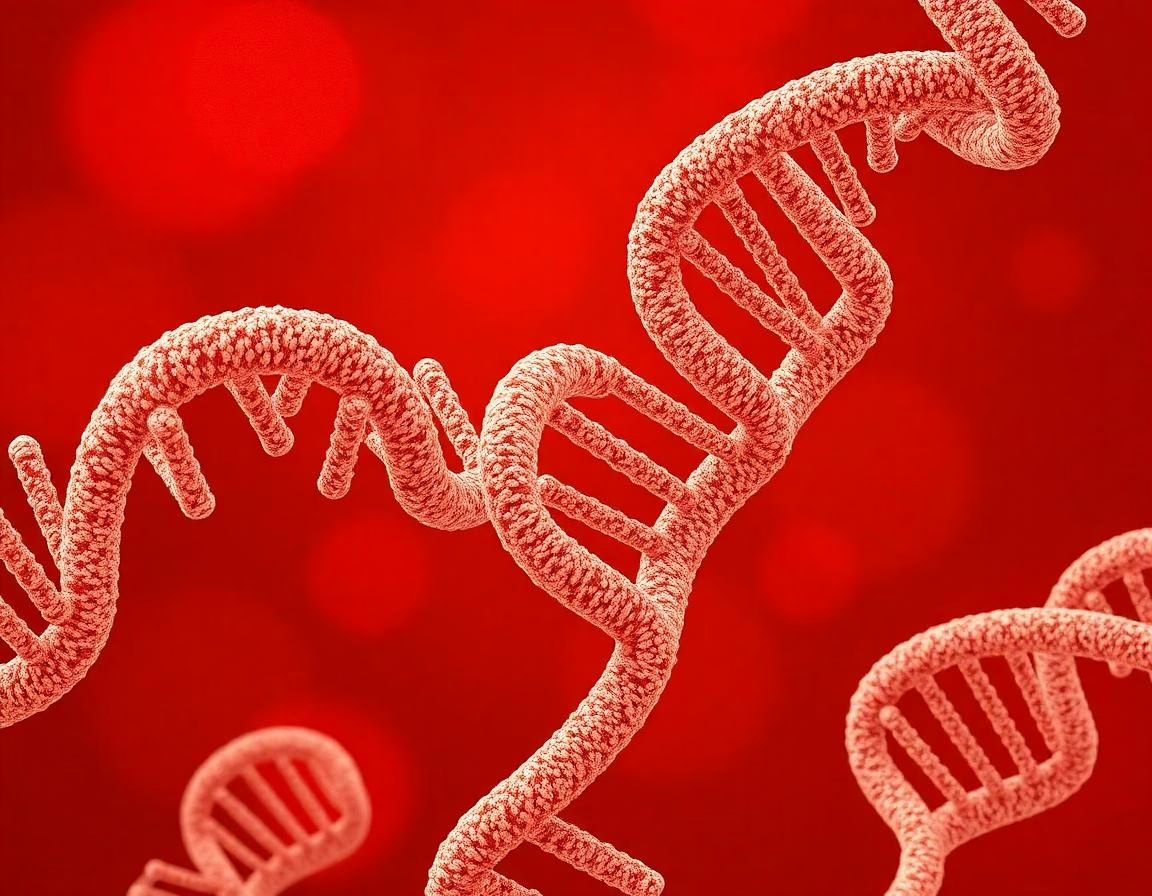
A groundbreaking discovery in the realm of biochemistry has revealed an RNA strand just 45 nucleotides long that exhibits the ability to perform two crucial reactions necessary for self-replication. This remarkable molecule, classified as a type of RNA enzyme, sheds light on the enigmatic beginnings of life on Earth, particularly how non-living chemical compounds transitioned into self-replicating entities capable of evolution.
The Significance of Self-Synthesis
Lead researcher Edoardo Gianni, alongside his colleagues in Philipp Holliger’s lab at the MRC Laboratory of Molecular Biology in Cambridge, underscores the distinction between self-synthesis and true self-replication. They explain that while the reactions observed do not occur sequentially or simultaneously, the capability of this RNA to replicate itself, as well as synthesize its complementary strand, is a significant finding. Until now, such dual capabilities had not been demonstrated by any known polymerase ribozyme.
The RNA world hypothesis posits that early life forms were primarily RNA-based, emerging from a primordial chemical environment. These molecules would have encoded genetic information while simultaneously catalyzing the reactions necessary for self-replication, paving the way for the evolution of DNA and proteins.
Polymerase Ribozyme Evolution
While polymerase ribozymes do not exist in any known current life forms, researchers have successfully engineered them in laboratory settings. Traditionally, these ribozymes are known to assist in the synthesis of RNA molecules, suggesting a pivotal role in the origins of life. However, the complexity of existing ribozymes, characterized by lengthy nucleotide sequences and intricate folding patterns, makes spontaneous emergence on prebiotic Earth seem improbable.
Gianni and his team recognized this limitation and decided to pursue a new approach. They embarked on an ambitious experiment utilizing directed evolution to sift through a staggering one trillion random RNA sequences. This innovative method ultimately led to the creation of QT45, a ribozyme only 45 nucleotides long.
Discoveries in Prebiotic Conditions
The research team conducted experiments using a eutectic ice environment—a slushy mixture of water and salts known to enhance polymerase activity. This setting is considered a plausible analog for conditions on prebiotic Earth. Remarkably, QT45 demonstrated the ability to catalyze the synthesis of its complementary strand and replicate itself, albeit at a slow rate. After 72 days, the yield of copies reached a mere 0.2%.
David Lilley, a molecular biologist at the University of Dundee, commented on the slow replication process, noting that while the rate is unremarkably low, it represents a vital step toward validating the RNA world hypothesis. The findings suggest that shorter strands of RNA, such as QT45, could have been more prevalent in early chemical environments, allowing for greater opportunities for replication and evolution.
Implications for the Emergence of Life
Gianni emphasizes that these findings significantly lower the threshold for non-enzymatic processes to achieve RNA synthesis before ribozyme-catalyzed replication can occur. This shift in understanding increases the likelihood of life spontaneously emerging from purely chemical processes, a notion that has captivated scientists for decades.
Looking ahead, Gianni and his team aim to advance their research by attempting to conduct both key reactions in a single pot. This integration would bring them closer to achieving self-replication within the RNA strand. Furthermore, they aspire to enhance the yields of QT45 to a level where the system can sustain itself, grow, and eventually evolve.
Future Directions in RNA Research
The implications of this research extend beyond mere curiosity about the origins of life. Understanding the self-synthesizing capabilities of RNA could have profound applications in biotechnology, from drug development to synthetic biology. The potential to harness these insights could lead to innovations that mirror the fundamental processes of life.
As scientists continue to explore the properties and functions of RNA, the path to understanding the intricate dance between chemistry and biology becomes clearer. Each discovery serves as a stepping stone, illuminating the mysterious transition from non-living molecules to the vibrant tapestry of life we see today.
Key Takeaways
- A newly identified RNA strand, QT45, performs essential reactions for self-synthesis.
-
This discovery supports the RNA world hypothesis, suggesting that early life was RNA-based.
-
The research emphasizes the significance of shorter RNA strands in the early chemical environment of Earth.
-
Future experiments aim to achieve self-replication and improve yield efficiency.
-
The findings could catalyze advancements in biotechnology and synthetic biology.
In conclusion, the revelation of QT45 not only advances our understanding of life’s origins but also opens new avenues for exploration in biochemistry and molecular biology. As research progresses, who knows what further secrets the RNA world may unveil?
Read more → www.chemistryworld.com



