
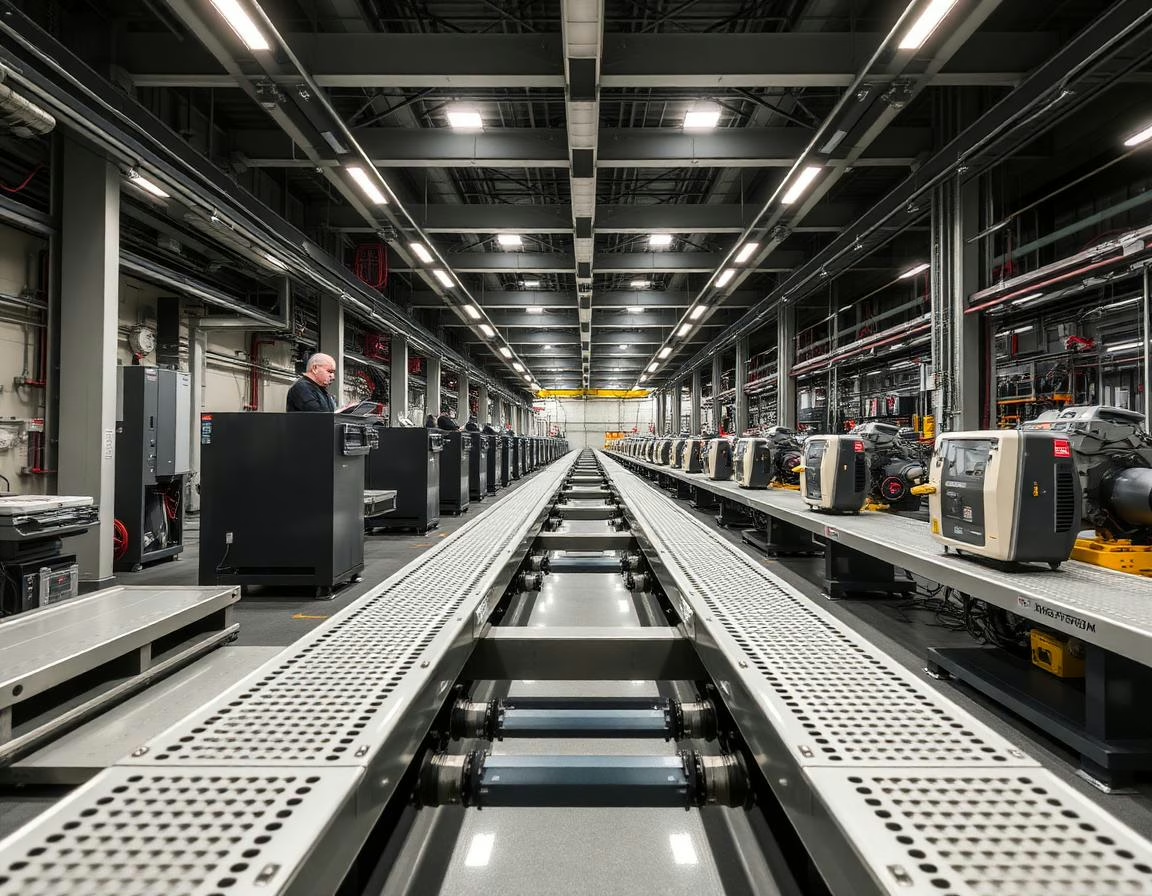
The pharmaceutical industry is witnessing a significant transformation thanks to advancements in continuous manufacturing. This innovative approach to drug production promises to enhance efficiency, reduce costs, and ensure higher quality in solid-dosage forms. With the support of regulatory bodies, collaborative research efforts, and the establishment of new facilities, continuous manufacturing is gaining momentum and reshaping the landscape of pharmaceutical manufacturing.
Regulatory Frameworks and Best Practices
In June 2016, a pivotal moment occurred when a working group from the Center for Structured Organic Particulate Systems (C-SOPS) submitted a best practices guide to the FDA. This guide, crafted by volunteers from 16 different companies, aimed to set forth foundational methodologies for continuous solid-dosage drug manufacturing. By addressing areas such as system selection, implementation, control, and optimization, the document serves as a valuable resource for industry stakeholders.
Following its release, the FDA sought public comments on the guide, emphasizing the need for collaborative input from the industry. This initiative reflects a broader desire to create a cohesive regulatory framework that not only clarifies expectations but also encourages innovation in continuous manufacturing practices. The dialogue between the FDA and industry players marks a significant step toward establishing common guiding principles that can lead to the widespread adoption of continuous manufacturing.
Industry Innovations and Collaborations
The commitment to continuous manufacturing is evident in recent industry developments. A notable example is Pfizer’s Freiburg facility, which recently launched a Portable, Continuous, Miniature, and Modular (PCMM) facility. This innovative setup, a collaboration between Pfizer, GEA, and G-CON Manufacturing, integrates multiple production steps—supplying, feeding, and mixing—into a streamlined continuous system. Such advancements reflect the industry’s drive to enhance productivity while maintaining stringent quality standards.
The continuous manufacturing landscape is not only evolving through individual company efforts but also through collaborative initiatives. The upcoming industry conference hosted by C-SOPS is designed to foster dialogue and knowledge sharing among stakeholders. Scheduled for October 2017, the event will feature workshops and a mini-course aimed at introducing continuous manufacturing concepts. Additionally, the launch of the New Jersey Continuous Manufacturing Institute (NJCMI), a joint effort between Rutgers University and The New Jersey Innovation Institute, stands as a testament to the industry’s commitment to facilitating the implementation of these advanced manufacturing practices.
Educational Initiatives and Community Engagement
The C-SOPS conference will play a crucial role in educating industry professionals about continuous manufacturing processes. The mini-course will cover product and process design, regulatory considerations, and implementation strategies, providing a comprehensive overview for participants. Workshops will delve into specific challenges and opportunities within the continuous manufacturing framework, fostering a rich environment for learning and innovation.
Engagement with academia is another vital component of advancing continuous manufacturing. The NJCMI aims to bridge the gap between theoretical research and practical application. By collaborating with industry leaders and educational institutions, the institute will provide resources and support for companies looking to transition to continuous manufacturing systems.
Overcoming Challenges and Addressing Concerns
While the potential benefits of continuous manufacturing are clear, the industry must navigate several challenges. Key among these concerns is the definition of a “batch” in a continuous process, as traditional manufacturing paradigms often rely on batch production models. Addressing this issue requires a rethinking of regulatory definitions and a willingness to adapt existing frameworks to accommodate new manufacturing paradigms.
Moreover, companies must focus on process monitoring and control to ensure the integrity and quality of products produced through continuous systems. The best practices guide developed by C-SOPS emphasizes the importance of robust sampling plans and real-time monitoring to mitigate risks associated with continuous manufacturing.
Future Prospects and Conclusion
The future of continuous manufacturing in pharmaceuticals looks promising. As regulatory frameworks evolve and industry players collaborate to share knowledge and best practices, the potential for innovation is vast. The ongoing dialogue between the FDA and industry stakeholders will play a pivotal role in shaping the regulatory landscape, ultimately driving the successful implementation of continuous manufacturing.
In conclusion, continuous manufacturing is not merely a trend; it represents a paradigm shift in how pharmaceuticals are produced. With concerted efforts from regulatory agencies, industry leaders, and academic institutions, the journey toward a more efficient and effective manufacturing process is well underway. As this field continues to develop, the pharmaceutical industry stands poised to reap the benefits of a more agile, responsive, and quality-focused production system.
- Continuous manufacturing enhances efficiency and quality in drug production.
- Collaborative efforts among industry leaders and regulatory bodies are shaping best practices.
- Educational initiatives are crucial for fostering knowledge and innovation in continuous manufacturing.
- Addressing challenges such as batch definitions and process monitoring is essential for success.
- The future of continuous manufacturing is bright, promising a transformative impact on the pharmaceutical landscape.
Source: www.pharmtech.com



