
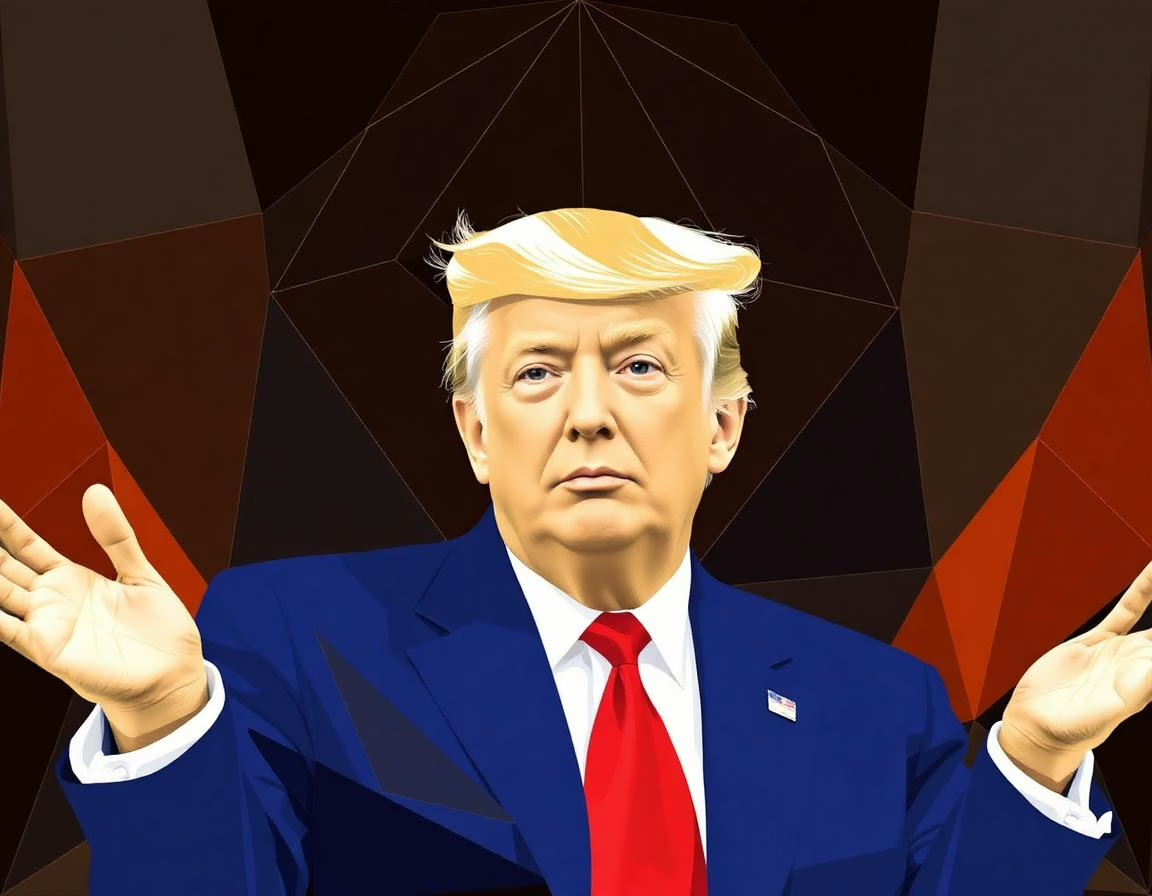
As discussions about Donald Trump’s health heighten, a multitude of concerns emerges regarding his fitness for office. With predictions about his wellbeing surfacing from various quarters, including a group of Peruvian shamans, the focus has shifted to tangible signs of physical and cognitive decline observed in the former president.
The Shifting Narrative of Health
In late 2025, the conversation surrounding Trump’s health intensified. Observations made during public appearances revealed alarming signs of both physical and mental deterioration. Notably, Trump’s age—he will turn 80 in 2026—adds a layer of urgency to these discussions, as age-related health challenges become statistically more probable.
While shamanic predictions may be met with skepticism, they sometimes reflect a growing public concern. The shamans’ assertion that Trump would face serious health issues has resonated amid a backdrop of increasing scrutiny from medical experts.
Physical Signs of Deterioration
One of the most telling indicators of Trump’s health was revealed in February 2025, when images from a meeting with French President Emmanuel Macron showcased a bruised right hand, which was camouflaged with makeup. This sparked widespread concern and speculation about the underlying causes of his physical condition.
By summer, further scrutiny intensified as images of swollen ankles surfaced, leading to social media discussions about the implications of such symptoms. White House officials initially attributed these issues to minor causes, but as symptoms persisted, the explanations grew tenuous.
In July 2025, the White House confirmed that Trump had been diagnosed with chronic venous insufficiency (CVI). This condition, characterized by improper blood flow in the legs, is common among older adults. Despite being generally considered benign, the diagnosis raised questions about Trump’s overall health, especially given the ongoing presence of other symptoms.
Cognitive Decline: A Deeper Concern
Alongside physical symptoms, experts have begun to voice serious concerns regarding Trump’s cognitive health. An analysis of his speeches from 2025 compared to those from 2018 revealed a marked decline in verbal complexity. The reduction in vocabulary diversity and sentence length suggests deteriorating cognitive function.
A formal statement from the World Mental Health Coalition, consisting of prominent mental health professionals, documented these cognitive changes. They noted a troubling increase in grammatical errors and incoherent statements, as well as a pattern of repetitive speech.
Furthermore, researchers observed a significant rise in the use of profanity in Trump’s public remarks since 2016. This increase, coupled with tangential speech patterns, further highlights concerns about cognitive decline associated with aging.
Unspoken Dynamics: Succession and Legacy
The behaviors exhibited by members of Trump’s inner circle suggest an underlying acknowledgment of potential succession issues. Throughout 2025, key figures in his administration, including Vice President JD Vance and Secretary of State Marco Rubio, appeared to position themselves for leadership roles, hinting at an unspoken recognition of Trump’s health uncertainties.
In a revealing moment in May 2025, Trump privately conceded that he would not be the one to lead the party moving forward. This admission, coupled with his increasing focus on naming buildings and institutions after himself, suggests a preoccupation with legacy—a sign of awareness of mortality.
The Official Stance and Public Perception
Despite the mounting evidence of physical and cognitive challenges, White House officials have consistently maintained that Trump is in excellent health. Press Secretary Karoline Leavitt emphasized his work ethic and energy, contrasting him with other aging politicians.
However, the disparity between these official statements and observable symptoms has become increasingly difficult to overlook. The convergence of visible physical signs, cognitive assessments, and the dynamics within Trump’s administration indicates that questions about his fitness for office will persist.
The Road Ahead
As 2026 approaches, the scrutiny surrounding Trump’s health is unlikely to diminish. Whether the shamans’ predictions hold any truth remains uncertain, but the concerns voiced by medical professionals are grounded in observable reality. The combination of physical and cognitive decline could have significant implications for Trump’s role and the political landscape as a whole.
In a time when transparency in leadership is paramount, the ongoing dialogue about Trump’s health serves as a crucial reminder of the intersection between age, health, and governance.
- Key Takeaways:
- Trump’s physical symptoms have raised significant health concerns.
- Cognitive decline is evidenced by changes in his speech patterns and linguistic complexity.
- Internal dynamics within his administration hint at acknowledgment of succession issues.
- Official reassurances clash with growing public and medical scrutiny.
- The implications of Trump’s health could reshape the political landscape as 2026 approaches.
Ultimately, the future remains uncertain, but the interplay of health and politics will continue to shape discourse in the coming year.
Source: www.ibtimes.com