
Researchers have made a groundbreaking revelation, indicating that a staggering 74% of individuals harbor a novel genetic entity known as Inocles, potentially influencing oral health, immunity, and even the risk of cancer.
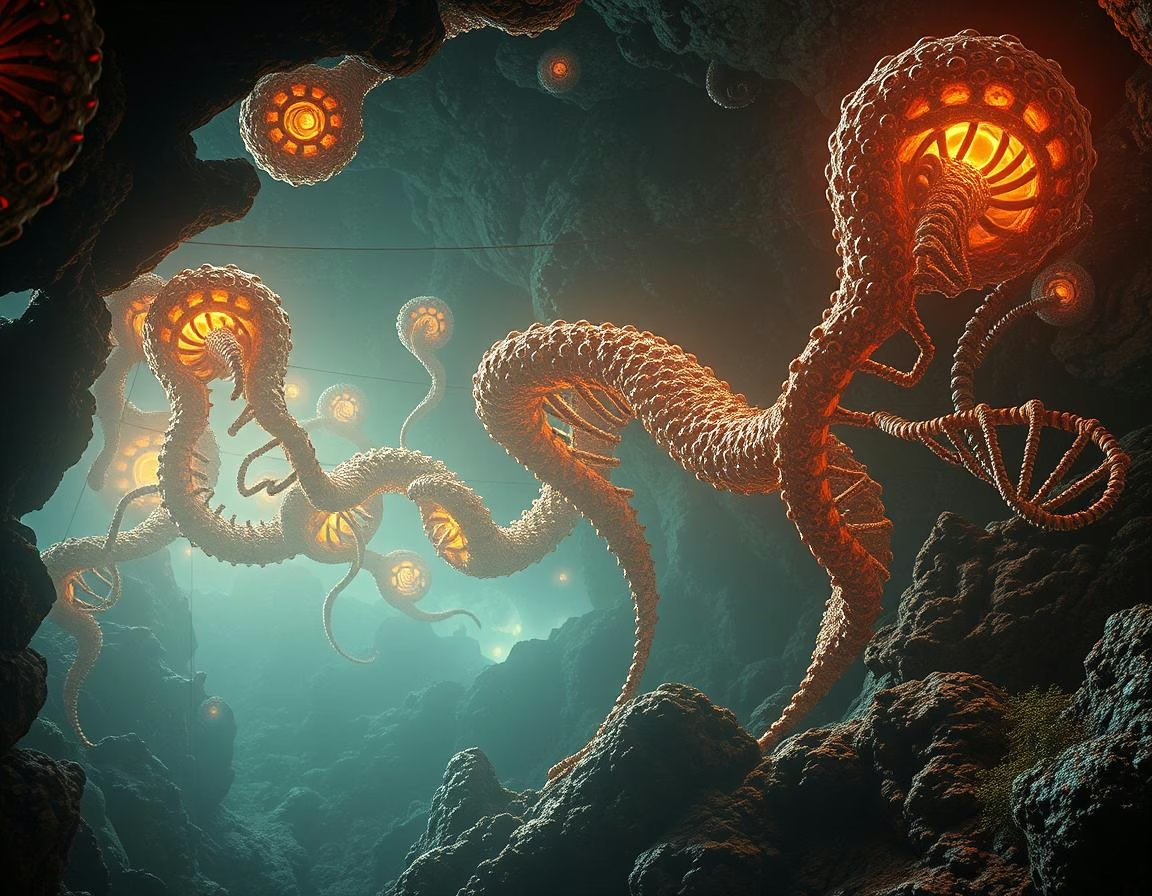
In a remarkable discovery, scientists at the University of Tokyo, in collaboration with other experts, have unearthed a hidden world within the human mouth—Inocles, colossal DNA structures that had eluded detection until now. These entities are believed to play a crucial role in assisting bacteria in adapting to the dynamic oral environment. Such findings provide fresh insights into the establishment and survival mechanisms of bacteria in the oral cavity, with profound implications for human health, disease development, and ongoing microbiome investigations.
Despite the prevailing notion that modern medicine has thoroughly mapped the human body, the past decade has witnessed the unearthing of previously unknown small organs, with the microbiome field experiencing a renaissance of discoveries.
This resurgence encompasses not only the gut microbiome but also the oral microbiome. Drawing inspiration from reports of peculiar DNA in soil microbiomes, Project Research Associate Yuya Kiguchi and his team delved into a vast repository of saliva samples amassed by the Yutaka Suzuki Lab at the Graduate School of Frontier Sciences, University of Tokyo. Their objective was to uncover analogous concealed DNA elements within human saliva.
“Inocles, an instance of extrachromosomal DNA existing in cells, notably bacteria, but external to their primary DNA, were discovered through this exploration,” stated Kiguchi. “Imagine stumbling upon a book embellished with additional footnotes, and we are only beginning to decipher their functions to unravel their mysteries.”
The identification of Inocles posed a challenge due to conventional sequencing methods fragmenting genetic material, hindering the reconstruction of large elements. To surmount this obstacle, the researchers employed advanced long-read sequencing technology capable of capturing extensive DNA segments.
A pivotal breakthrough came from co-first author Nagisa Hamamoto, who devised the preNuc methodology to selectively eliminate human DNA from saliva samples, significantly enhancing the sequencing accuracy of lengthy DNA fragments. Leveraging this approach, the team successfully assembled complete genomes of Inocles for the first time, revealing their residence in the bacterium Streptococcus salivarius, albeit discerning the host proved to be a complex endeavor.
“Inocle boasts an average genome size of 350 kilobase pairs, making it one of the largest extrachromosomal genetic elements in the human microbiome. In comparison, plasmids, another form of extrachromosomal DNA, typically range from a few tens of kilobase pairs at most,” elucidated Kiguchi. “This substantial length equips Inocles with genes conferring diverse functions, including oxidative stress resistance, DNA damage repair, and cell wall-related genes, possibly implicated in adapting to extracellular stress responses.”
The team is striving to establish robust methods for cultivating bacteria containing Inocles. This endeavor will enable them to delve into the functionality of Inocles, investigate their potential inter-individual transmission, and explore their impact on oral health conditions like cavities and gum diseases. Given that numerous Inocle genes remain uncharacterized, researchers will blend laboratory experiments with computational simulations, such as AlphaFold, to anticipate and model the roles Inocles might undertake.
“Remarkably, we estimate that 74% of the global population may harbor Inocles, based on the diversity of individuals represented in the saliva samples. Despite extensive studies on the oral microbiome, Inocles remained concealed due to technological constraints,” Kiguchi highlighted. “Now armed with this knowledge, we can embark on unraveling how Inocles shape the intricate dynamics between humans, their resident microbes, and our oral health. Moreover, there are indications that Inocles could potentially serve as markers for severe diseases like cancer.”
Takeaways:
– Inocles, the newly discovered genetic entities residing in the human oral cavity, may significantly impact oral health, immunity, and cancer susceptibility.
– The identification of Inocles sheds light on bacteria’s adaptation mechanisms in the oral environment, with far-reaching implications for human health and disease research.
– Advanced sequencing technologies and innovative methodologies have enabled the complete genome assembly of Inocles, unveiling their potential roles in oxidative stress response and DNA repair.
– Cultivating bacteria hosting Inocles will facilitate in-depth investigations into their functions, inter-individual transmission, and influence on oral health conditions, paving the way for novel insights and therapeutic avenues in microbiome research.
Tags: microbiome
Read more on scitechdaily.com



